
Posted: April 29, 2021
WHY SO SALTY? The negative impacts of road salts on freshwater organisms
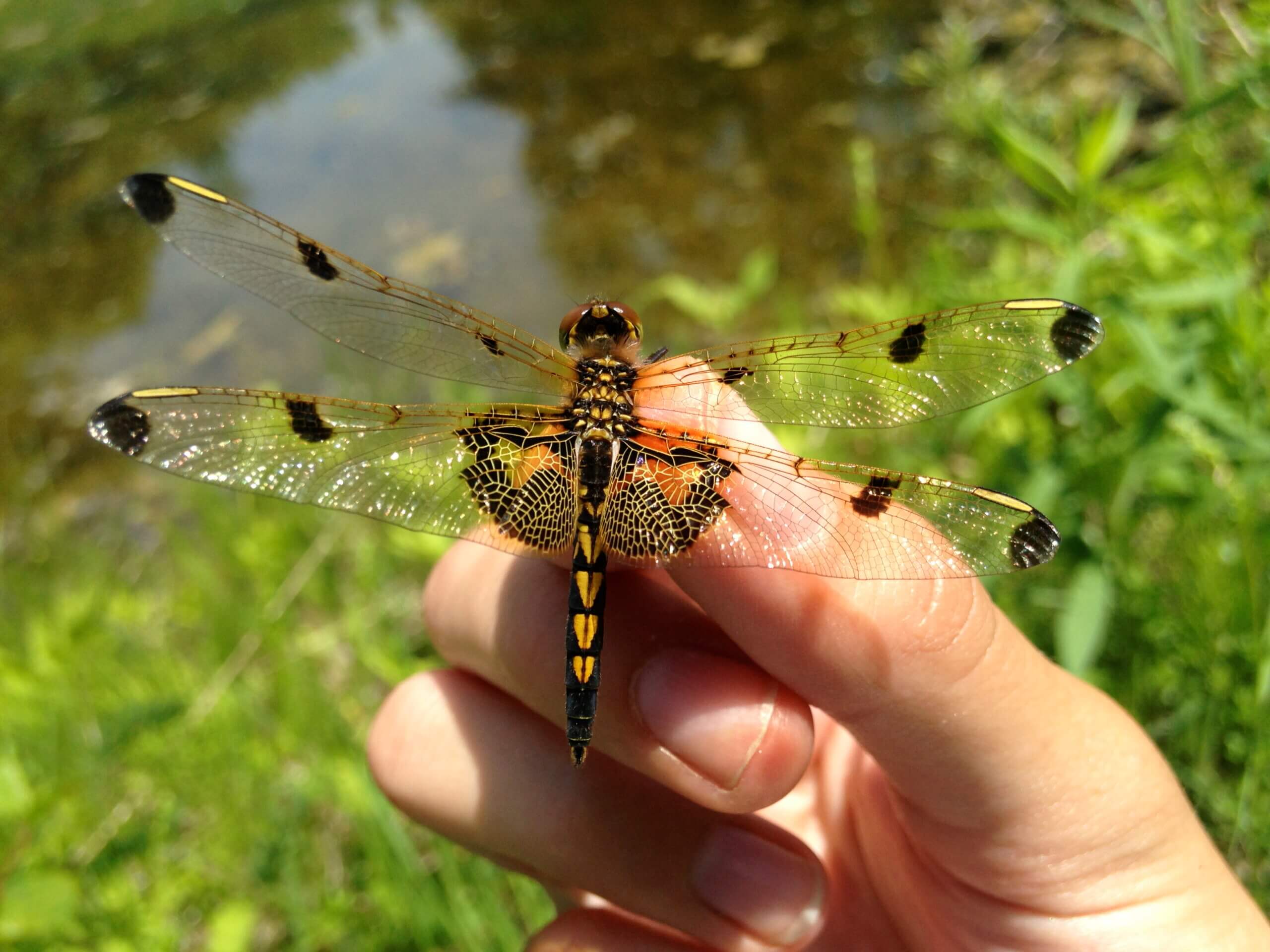
A guest blog from experts in the field that explores the impact that high chloride concentrations from excess road salt can have on freshwater organisms.
Written by Dr. Mary Ann Perrona,b, Liam Johnstona and Dr. Frances Picka
a University of Ottawa, and b St. Lawrence River Institute of Environmental Sciences
Road salts (the chloride salts of sodium, calcium, magnesium or potassium) are used to maintain ice-free conditions on roads, sidewalks and parking lots during the winter. However, did you know that road salts are one of the most ubiquitous pollutants in freshwater ecosystems in our region? In Canada, salt usage on roads is reported to be anywhere from 2 to 5 million tonnes annually1; this does not even include the salt that is applied to sidewalks or parking lots, which together likely doubles that amount. To put this into perspective, 5 million tonnes is equal to the average weight of 50,000 blue whales; we apply this much salt into the environment every single year. The problem is that these road salts do not stay on the roads and are eventually washed into surface waters during rain events and after snow melt (Figure 1).

Figure 1. Surface runoff
Our group at the University of Ottawa has been studying road salts that reach stormwater ponds. Stormwater ponds are built to collect surface runoff to reduce flooding and pollution of waters downstream. These ponds are common in residential areas across Ottawa. In our studies, we have found that road salt levels peak in these ponds during spring melt, as expected, with chloride ion concentrations sometimes reaching over 2,000 mg/L; the guideline in Canada for the protection of aquatic life is 120 mg/L 2. Throughout the summer and fall, although the levels decline, chloride concentrations can remain above this toxicological threshold.
Figure 2 shows the chloride levels from the outlet (where the water exits) of a stormwater pond at the end of April and again at the end of September. Both measurements are well above the guideline for the protection of aquatic life in Canada. In fact, 70% of the ~ 40 ponds we have sampled across Ottawa had chloride levels above the guideline for the protection of aquatic life during summer and fall months3, so the salt may be accumulating over time. This salty water will eventually enter natural ecosystems such as small streams, rivers and lakes.
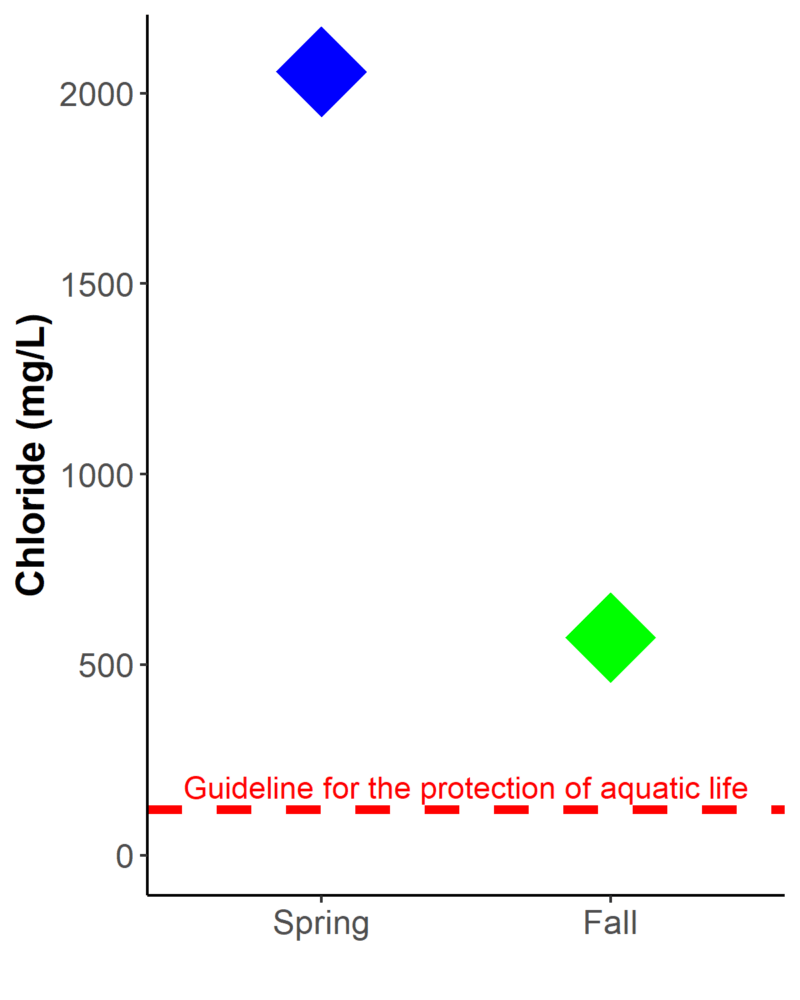
Figure 2. Chloride concentrations measured at the outlet of an Ottawa stormwater pond in spring and fall of 2016. The red dotted line denotes the guideline for the protection of aquatic life.
Freshwater organisms typically maintain internal ion concentrations higher than the surrounding water4. They achieve this by absorbing ions from the environment and excreting water. Road salts increase the concentration of many different ions, including chloride, in water bodies. There are two main strategies that freshwater animals use to tolerate these high levels5. They can either allow ions to enter their bodies naturally and match their internal concentrations to the environment or stop absorbing ions from the environment and maintain their internal ion levels as the environment changes. However, high ion levels in the environment can affect the ability of freshwater organisms to maintain their internal concentrations. When ion levels in the environment are higher than the concentrations in their bodies, freshwater organisms risk ions entering their bodies rapidly, potentially rising to toxic levels.

Chloride ions affect different groups of organisms in different ways. For example, certain species of zooplankton (microscopic invertebrates living in the water column) can withstand moderate chloride levels, while others are highly sensitive and grow increasingly stressed with even small increases in chloride levels6. However, when chloride concentrations are too high, zooplankton population growth in general slows down and individuals begin to die off in large numbers. Zooplankton are critical members of aquatic food webs and are important in the diets of many animals. A decline in zooplankton negatively affects those animals that are higher up on the food chain which rely on them. Additionally, less zooplankton can also lead to increases in the algae which they feed on, thereby potentially contributing to dangerous algal blooms6.
Macroinvertebrates vary widely in how much chloride they can tolerate. Mussels, snails, and worms are some of the more vulnerable groups while crustaceans and insects are some of the more tolerant groups4,7. However, not all insects are tolerant to high chloride levels. Vulnerable insect groups include mayflies, caddisflies, and stoneflies4,5,8. In stormwater ponds across Ottawa, we found that there were fewer dragonflies in ponds with high chloride levels, whereas damselflies were more tolerant3. Amphibians have very permeable skin that easily allows water and oxygen to pass through, but also makes them vulnerable to high chloride levels4. All amphibian life stages can experience reduced activity, lower growth rates and death, but the earlier life stages (eggs and tadpoles) are generally more sensitive than the adult stages9. The effects of chloride on all these groups of organisms have impacts on the entire freshwater ecosystem.
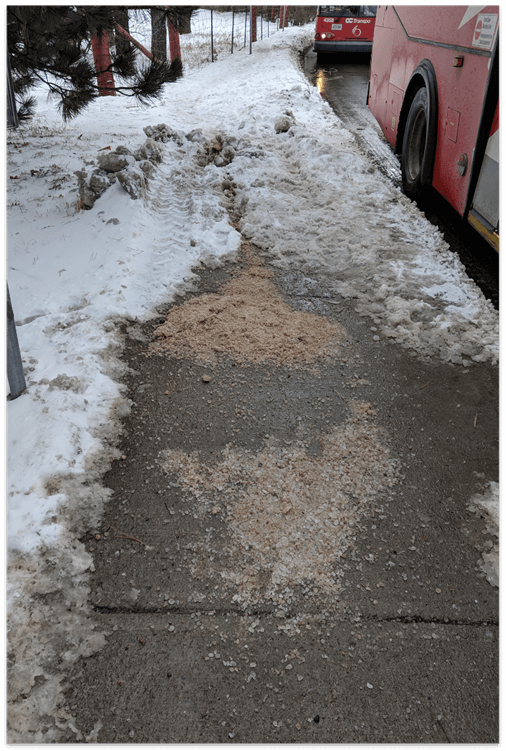
Figure 3. Salt mound on a sidewalk, Ottawa, Ontario
There is very little policy surrounding road salt usage in Canada. Canadian cities are encouraged to follow salt management plans and to report road salt usage on major routes1. There is no policy surrounding road salt application on walkways and parking lots. Have you noticed over-salting in your neighbourhood (Figure 3)? Mounds of salt unevenly spread are doing more harm than good. Salt usage has other consequences such as accelerating rust on vehicles and corroding concrete. This is a problem we can address and where policy surrounding usage is urgently needed. You can help by raising awareness on the environmental impacts of road salts and using alternatives that give traction, such as sand and gravel, around your home or workplace.
References
[1] Environment Canada (2012) Five-year Review of Progress: Code of Practice for the Environmental Management of Road Salts. 95 pp. http://publications.gc.ca/collections/collection_2012/ec/En14-54-2012-eng.pdf
[2] Canadian Council of Ministers of the Environment. (2011). Canadian water quality guidelines for the protection of aquatic life: Chloride. In: Canadian environmental quality guidelines, 1999, Canadian Council of Ministers of the Environment, Winnipeg.
[3] Perron, M. A. C., & Pick, F. R. (2020). Water quality effects on dragonfly and damselfly nymph communities: A comparison of urban and natural ponds. Environmental Pollution, 263. https://doi.org/10.1016/j.envpol.2020.114472
[4] Cañedo-Argüelles, M., Kefford, B. J., Piscart, C., Prat, N., Schäfer, R. B., & Schulz, C. J. (2013). Salinisation of rivers: An urgent ecological issue. Environmental Pollution, 173, 157–167. https://doi.org/10.1016/j.envpol.2012.10.011
[5] Evans, M., & Frick, C. (2001) The effects of road salts on aquatic ecosystems. Saskatoon, Saskatchewan: Environment Canada – Water Science and Technology Directorate.
[6] Moffett, E. R., Baker, H. K., Bonadonna, C. C., Shurin, J. B., & Symons, C. C. (2020). Cascading effects of freshwater salinization on plankton communities in the Sierra Nevada. Limnology and Oceanography Letters. https://doi.org/10.1002/lol2.10177
[7] Hart, B. T., Bailey, P., Edwards, R., Hortle, K., James, K., McMahon, A., … Swadling, K. (1991). A review of the salt sensitivity of the Australian freshwater biota. Hydrobiologia, 210(1–2), 105–144. https://doi.org/10.1007/BF00014327
[8] Castillo, A. M., Sharpe, D. M. T., Ghalambor, C. K., & De León, L. F. (2018). Exploring the effects of salinization on trophic diversity in freshwater ecosystems: a quantitative review. Hydrobiologia, 807(1), 1–17. https://doi.org/10.1007/s10750-017-3403-0
[9] Albecker, M. A., & McCoy, M. W. (2017). Adaptive responses to salinity stress across multiple life stages in anuran amphibians. Frontiers in Zoology, 14(1). https://doi.org/10.1186/s12983-017-0222-0
Road salt may be of some concern to some but the more heightened level of anxiety is how the City of Ottawa Council or anyone else for that matter seems to be complacent with the Atomic Energy plans of importing and burying nuclear waste with vague assurance that we will have safety for at least 500 years. If anything happens to prove them wrong, the ground and river water of the Ottawa will be contaminated and unusable for thousands of years to come. That is a more frightening prospect than salt. What say your Riverkeeper?
The community housing plough dumed copious amount of salt under a 65 year oldtree that i nurtured with plant under cover
X one year the tree died and shed its bark
It was thriving till the dump.i created pollinator habitat now ragweed is the opportunist. I live-byk the Rideau for .26 years
Stop the road salt .eats our pavement