PFAS, the “forever chemicals”
PFAS is short for per- and poly-fluoroalkyl substances, artificial chemicals used in a variety of products. They are known to have harmful health impacts on humans and other organisms exposed to them.
The Issue
You may have heard of PFAS, or Per- and Poly-fluoroalkyl substances, before. They are a class of synthetic chemical substances recently listed under the Canadian Environmental Protection Act (CEPA). While their unique properties, such as high heat resistance, make them useful in many products, these traits also mean that they don’t break down under natural conditions and are extremely challenging to remove from the environment. Due to their persistence, PFAS are referred to as “forever chemicals”.
These “Forever chemicals” can enter the environment in many different ways, mainly through waste disposal. In waste facilities, PFAS can leak out of waste and accumulate in leachate or be turned into biosolid fertilizers, eventually entering the environment. Once released, PFAS can be easily transported to aquatic ecosystems where they are known to bioaccumulate in species and cause a range of harmful effects. PFAS exposure has been linked with reduced reproductive effects, increased cancer risk, and impaired immune function in both humans and other wildlife. PFAS are very mobile and can be found almost everywhere; chances are, you have something in your home that contains PFAS.
Can you identify which products have PFAS? Click on each one to learn more, including what alternatives might be available.

Non-stick Cookware
The slippery, non-stick surface that makes cooking so much easier is often made using PFAS. Teflon is a common brand name for non-stick cookware that contains Polytetrafluoroethylene, a “forever chemical”. If scratched or exposed to high heat, non-stick surfaces can release PFAS.
Alternatives include stainless steel or cast-iron pans. Silicone is also a safer non-stick alternative for other cookware.
Food Packaging Material
Take out food containers, wrappers for hamburgers or sandwiches, pizza boxes, paper plates, and microwave popcorn bags can contain PFAS to prevent the packaging from soaking up fats and water.
While there are alternatives, like wax papers, it can be unclear which packaging contains PFAS. One way to avoid PFAS altogether is to use a reusable food container, when possible.
Drinking Water
PFAS have been detected in the source water for drinking water. This is often associated with their prevalence in the environment, and while PFAS concentrations are low in most locations, this remains an issue to watch.
Fortunately, the City of Ottawa’s water treatment plant regularly tests for many contaminants, providing a snapshot of what is present in the region’s drinking water. Results from 2024 show that drinking water from the different drinking water treatment facilities in the city remains far below the threshold set by Health Canada. In fact, of the multiple types of PFAS tested for, only one test had a detectable level of PFAS.

Cosmetics
Some cosmetics contain PFAS to improve the penetration of other ingredients into the skin, enhance brightness, and increase the durability of makeup.
There are many alternative substances that can replace PFAS in cosmetics, but most require a full reformulation of the product. One alternative is to use cosmetics that clearly indicate that they are free from PFAS.
Cleaning Products
Effective cleaners often use PFAS for their ability to remove oils and dirt with ease.
Luckily, there are many PFAS-free cleaning products available on the market, but they may not be easy to identify.
Paint, coatings, adhesives and sealants
PFAS are added to some paints and coatings to improve the weatherability and durability of the coating. In adhesives and sealants, PFAS increase penetration and bond with the surface.
There are many alternatives being tested in these products, however it may be challenging to know if PFAS are being used, unless it is clearly marked on the packaging.
Textiles
Many textiles have been treated with PFAS in order to make them waterproof, stain-proof, and heat-resistant.
Various alternatives are being tested for the manufacturing of textiles, though some proposed alternatives have other adverse impacts. Some clothing brands provide additional manufacturing details to help inform customers, including stating if the items are PFAS-free.
How are we helping?
While individual choices can help reduce exposure, the real responsibility for addressing PFAS lies with manufacturers and regulators. Ottawa Riverkeeper remains steadfast in addressing the presence of these harmful chemicals with urgency.
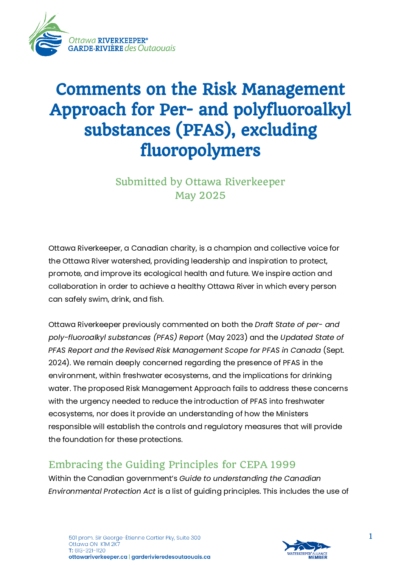
Ottawa Riverkeeper has commented on the federal government’s Risk Management Approach for PFAS to address concerns around the timeline of the phases, the exclusion of Fluoropolymers, and the need for better monitoring. We continue to monitor any changes in PFAS regulation and new advancements closely to protect the Ottawa River watershed.
Increased urgency in regulating PFAS
Currently, Canada is using a phased approach for regulating PFAS. The first phase is about regulating PFAS in firefighting foam, scheduled to start in 2027 and run through 2029. Once completed, the second phase of regulating PFAS in hundreds of other items with known replacements will begin its years-long process.
A more appropriate response would be to regulate PFAS with known alternatives in concert with firefighting foams. Both phase 1 and phase 2 of Canada’s regulatory plan are equally important, and both require the same amount of urgency. Completing these phases in tandem would also allow for more time to research phase 3, which includes all other products for which there are currently no known alternatives.
Take action!
We need your help to send the message that more urgency is needed! Fill in your name and riding on the form below to send an emailed letter to your local MP, alongside the Minister of Health and the Minister of Environment and Climate Change, that asks for phase 2 of PFAS regulation to be accelerated.
PFAS monitoring in the Ottawa River watershed
Ottawa Riverkeeper has also launched a monitoring program in 2025/2026 to collect data on PFAS in the Ottawa River watershed. Currently, the federal government only monitors PFAS on federally owned properties, ignoring the potential contamination from numerous industrial sites, airports, wastewater treatment facilities, mining operations and more. Once completed, data from our monitoring will be made available to the public and will provide a more accurate picture of how widespread PFAS are in the Ottawa River watershed.

The exclusion of fluoropolymers
Fluoropolymers, a subgroup of PFAS, are not currently being included in any regulations. This is potentially due to pressure from industry alongside a lack of study into their harmful effects. Unfortunately, there is little to no information on when or how these studies would be conducted.
Ottawa Riverkeeper believes that Fluoropolymers should also be listed as toxic alongside all other PFAS and fully regulated until further studies can prove that they are safe. We have been in discussions with government officials to reinforce our case, and we will continue to push for stricter regulations.
Funding for our PFAS work comes from: