Road Salt Monitoring

Did you know that road salt can be toxic to aquatic environments? What could be learned if we could directly measure the impact of road salt on our watershed?
In early 2020, Ottawa Riverkeeper piloted a new community based monitoring initiative, to find out if winter salt use was leading to harmful chloride levels in creeks in Ottawa and Gatineau. With the help of five citizen scientists volunteers we were able to collect data from five creeks receiving road salt runoff, to gain a better understanding of how winter salt may be affecting chloride concentrations. Even though we expected to see high concentrations, we were still shocked by the results.
In March 2021 we officially published a report summarizing our findings, which clearly showed that chloride concentrations were well above levels that are considered safe for freshwater life.
With the pilot study completed, we decided to dive even deeper.
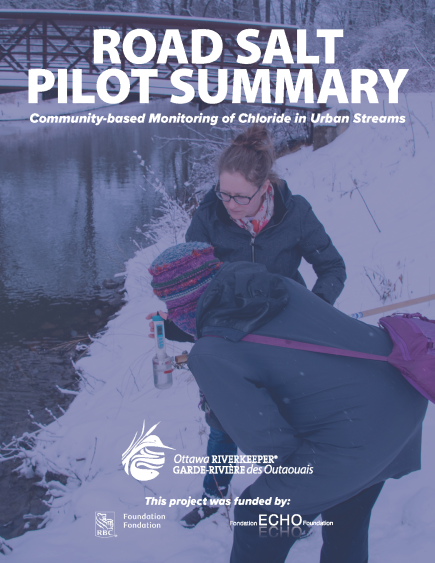
Over the 2020/2021 winter season Ottawa Riverkeeper, in partnership with the Agence de bassin versant des sept (ABV7) and Friends of the Gatineau River (FOG), was able to expand the reach and scope of our road salt monitoring program. We recruited 9 new volunteer citizen scientists, who collected over 300 data points from 17 locations in Ottawa, Gatineau, and the Chelsea-Wakefield area! Our monitoring work has continued since this expansion highlighted the need for vigilance in streams across the region. Our efforts remain directed at monitoring some key sites, but we are also trying to understand the state of different creeks across the region.
We aren’t just sitting on the information we collect through this program. With the data from our growing group of volunteer road salt monitors in hand, we approached winter maintenance stakeholders across Ottawa and Gatineau with evidence highlighting the critical need for a reduction in the amount of salt used in the winter. With funding support through the Ontario Ministry of the Environment’s Great Lakes Local Action Fund, we are helping to educate and support winter maintenance stakeholders in the City of Ottawa who are committed to reducing their winter salt use and we are studying how these reductions in salt use may alleviate chloride stress on nearby waterways.
Digging deeper
What does the data say?
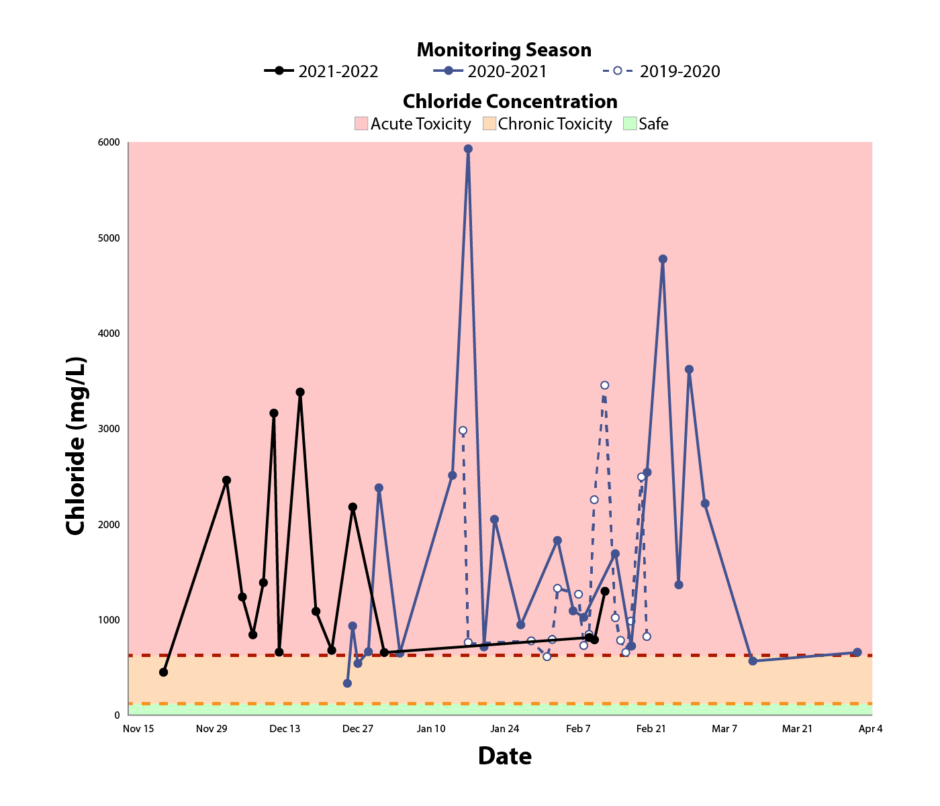
Overwhelmingly, chloride concentrations in Ottawa and Gatineau creeks become elevated during the winter months and pose a danger to local freshwater life. Our monitoring program has expanded over the years to include new sites, however we have also continued our monitoring year-after-year in sites with the most troubling trends.
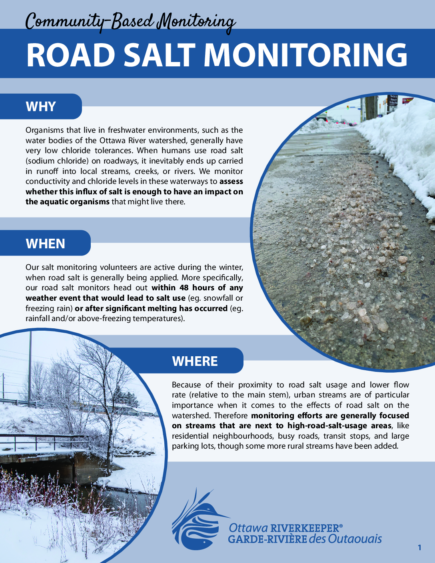
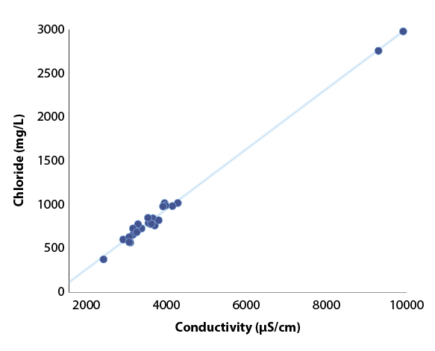
Volunteers across the region collect water samples in response to conditions that encourage salts to enter creeks; conditions including snow-melting temperatures, freezing rain, and snowfalls. In response to these events, the water samples we collect usually exceed the chronic toxicity threshold value (120 mg/L). In fact, the average concentration of chloride we measure is nearly double that value.
Familiar waterways like Pinecrest Creek, Nepean Creek, and Moore Creek are consistently recorded at concentrations that even exceed the acute toxicity threshold value (640mg/L). In some instances, chloride concentrations can exceed that acute toxicity threshold value by many times. In fact, the greatest chloride concentration recorded through our program was in Green’s Creek, when a one-time measurement of 25000 mg/L was collected. This concentration approaches the chloride content of ocean water!
Results from our road salt monitoring program can be explored and visualized in our Open Data Portal.
Rural vs Urban
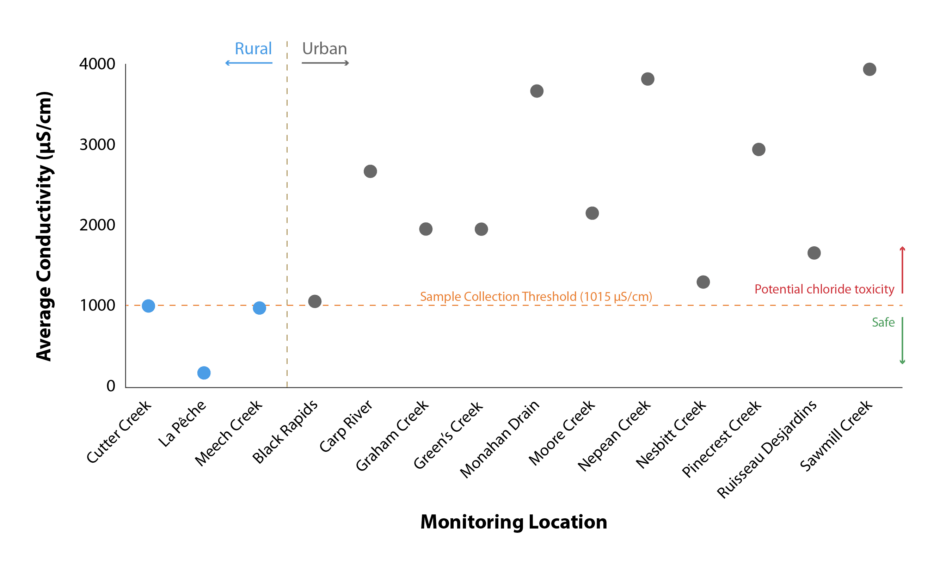
Our partnership with ABV7 and FOG in the 2020-2021 winter season saw us collecting samples from more locations where road salt is much less frequently used. Unsurprisingly, chloride concentrations at these locations were significantly lower than those seen in the samples collected in the cities of Ottawa and Gatineau where winter salt use is much higher.
City of Ottawa Historic Chloride Data

The City of Ottawa collected water quality data, including chloride concentrations, from 1998 to 2017. The monitoring locations include a few of the same streams that Ottawa Riverkeeper is currently monitoring. Here we show data for Graham and Pinecrest Creeks.
It is interesting to note that in most years the City only collected samples for chloride analysis between the months of April and November. Chloride levels tend to be highest during the winter months (coinciding with increased use of road salt). Since there are a number of years where there was no data collected from December to March, the percentage of acutely toxic chloride levels in these streams may be higher than this dataset suggests!
In both creeks, the majority of water samples were above the chronic toxicity threshold of 120 mg/L.
Thank you to Caduceon Laboratories Ottawa for donating lab time and analysis to support this work.