
Fish Richness
Project main page || Data || Relationships || Further resources
Introduction:
The Ottawa River is home to an incredible diversity of fish species, from the prehistoric Lake Sturgeon who can live well past a 100 years old to small Cutlip Minnows that have a preference for clear, gravel bottomed streams to the elusive and mysterious American Eel that migrates to freshwater rivers to mature. The exact number of distinct species of fish that live in the Ottawa River watershed is not certain, but it is believed to be as many as 85! However, there is a lack of understanding of how the number of fish species present, known as fish richness, changes throughout the watershed. Furthermore, what little is known suggests that fish richness has significantly decreased in many areas along the mainstem of the Ottawa River over time.
Fish richness is often determined by the river’s characteristics and the habitat present that can support various fish species. Higher species richness is desirable in ecosystems, however an increase in fish richness could be due to the introduction of invasive species which can result in native species being negatively impacted. Additionally, degradation to habitat can reduce the number of fish species that can be supported and cause a reduction of fish richness. When examining watershed health, fish richness is studied to see how stable populations are over longer periods of time and, if there are changes, we know to take a closer look at what changes may be influencing fish populations.
Many species of fish are highly ecologically significant organisms in freshwater ecosystems. Changes in fish populations can have significant consequences for other organisms within the same ecosystem, and for the ecosystem itself. Conversely, changes to the ecosystem and organisms within it can have significant impacts on fish richness.
One factor that results in changes to fish richness can be when habitats become isolated and/or fragmented when barriers such as dams are installed and make parts of the river impassable. This limits populations that were historically present throughout much of the river and can result in a loss of fish richness. Dams within the Ottawa River have had profound impacts on migratory species such as Lake Sturgeon and American Eels. Denaturalization of shorelines can also impact fish populations, as the vegetation in riparian zones not only provides important fish habitat, it helps control water temperature, flow rate, and turbidity (stabilized shorelines means less erosion). Human activities have important impacts on fish diversity.
Furthermore, changes in environmental factors such as temperature, dissolved oxygen, and flow can be doubly harmful because benthic invertebrates, an important food source for some species, can be extremely sensitive to changes in those conditions. This highlights how even slight, otherwise negligible, changes in habitat conditions could dramatically impact food availability for fish species. Ice on and ice off can also influence fish richness both directly and indirectly, as they can serve as important biological cues for many aquatic species, so shifts in the timing of those events can impact vital behaviours like spawning and migration, as well as food availability (invertebrate spawning/hatching, plant growth, etc).
The fish data available for the Ottawa River has been collected through historical commercial fisheries as well as from the recreational fishing community and in support of their activities. One major challenge for understanding fish richness is the difficulty of confirming fish population in the Ottawa River. The available data indicates that there is a clear and worrisome trend of significant loss in fish richness in a number of reaches of the Ottawa River.
What do we know about fish richness in the watershed?
This map shows fish richness and how it has changed over time at various points along the mainstem of the Ottawa River. Current fish richness, the number of different species of fish that could be identified during Ontario’s 2008-2010 BsM survey, is represented by the relative size of the red circles and the white numbers within them. Historical fish richness, the number of different species that could be identified in previous studies reported in the scientific literature, is represented by the relative size of the transparent blue circles. The change in fish richness, the difference between the “Current” and “Historical” values, is represented by a yellow number above the red circle.
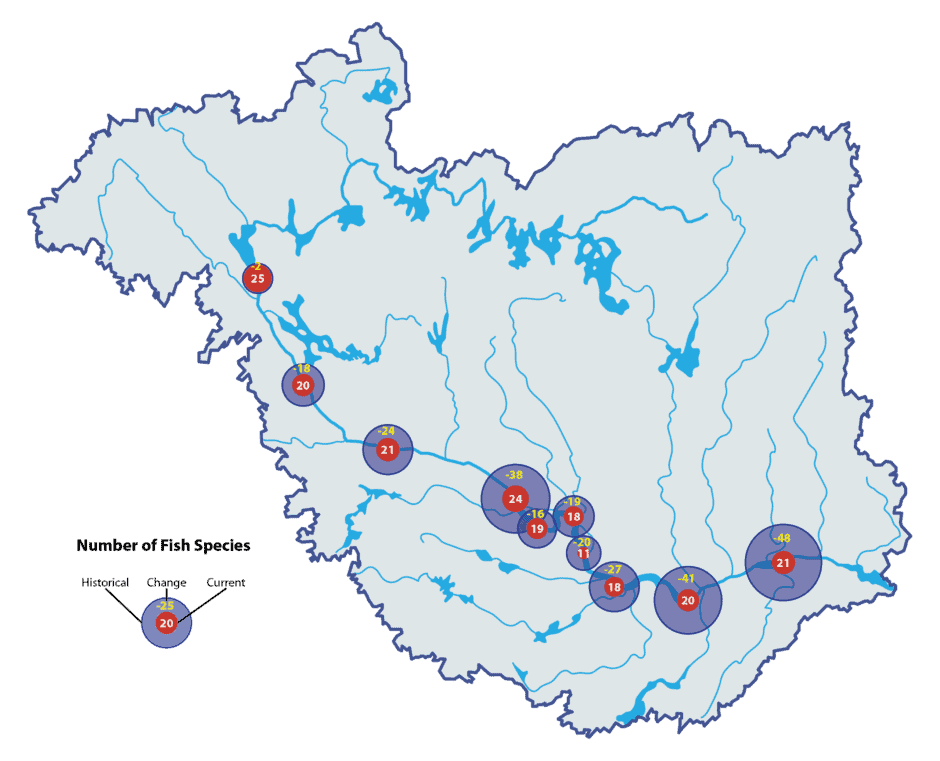
The number of different species that can be identified could be limited by sampling method, which may not have been consistent across all studies/surveys, and time between “Historical” and “Current” measurements is not the same for all locations, so changes in the number of fish species should be considered estimates. However, one consistent and obvious trend across this data is that fish richness is lower now than it used to be throughout most of the Ottawa River. Fish richness is a valuable indicator of ecosystem health, and more robust methods for monitoring it need to be implemented so that consistent and reliable ongoing analysis can continue.
Relationships to other indicators:
Fish Diversity
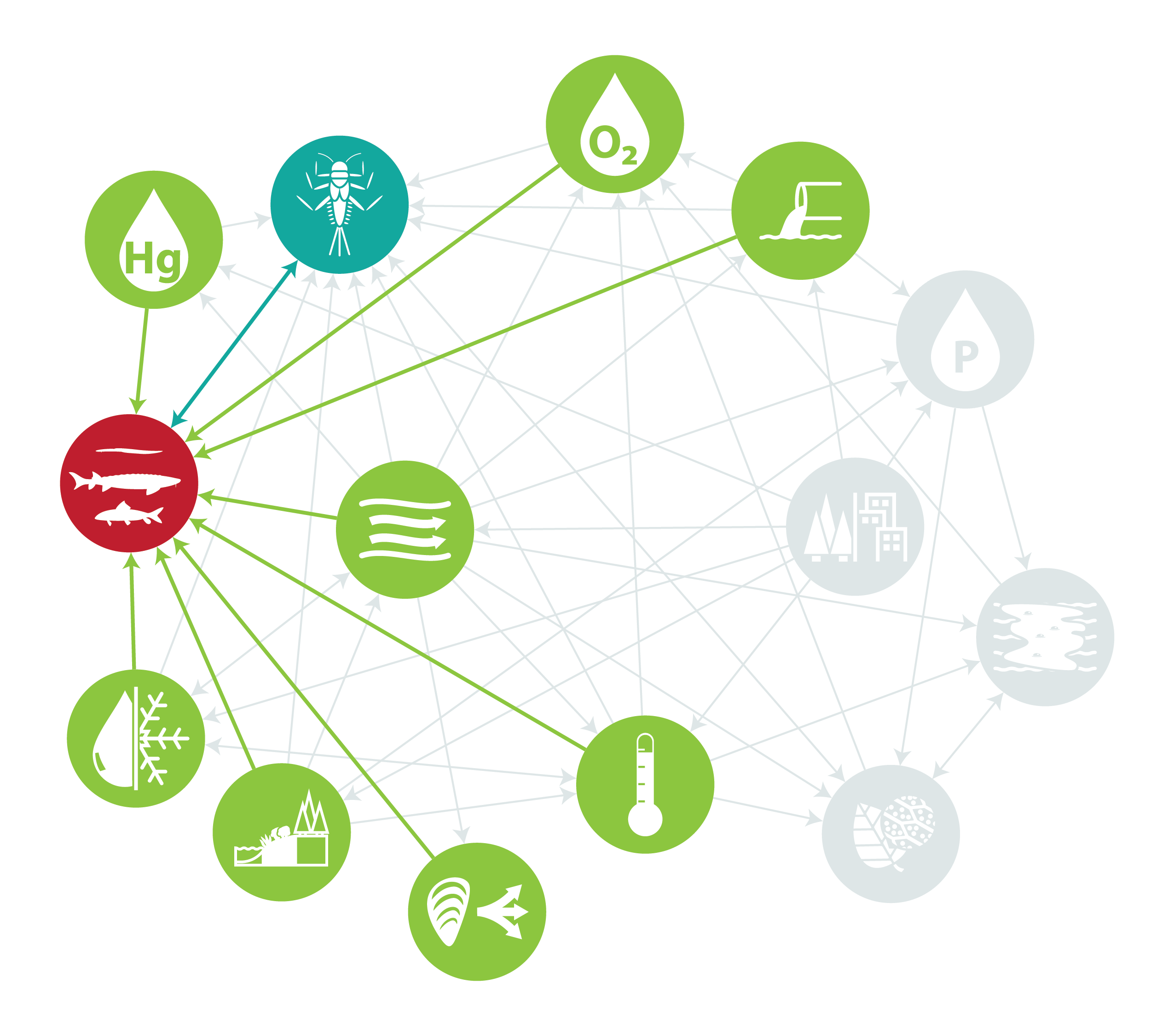
Fish richness is a measure of how many different species of fish are present in an ecosystem or habitat. Generally speaking, higher species richness is better, but some confounding factors include habitat type and the presence of invasive species (which can increase richness while threatening ecosystem health).
Algal Blooms
Algae are a group of single-celled and multicellular plant-like organisms. Algal growth contributes and supports the ecosystem in much the same way that plants do, through the production of oxygen and as a potential food source for smaller animals. However, when environmental conditions shift from their normal ranges, this can promote algal blooms, a rapid increase in population size of algae.
Water Temperature
With global temperatures on the rise, water temperature (particularly annual maximum temperatures) will be a crucially important indicator of watershed health moving forward. Water temperature is strongly correlated with a number of other important indicators of ecological status, and can often help to explain, give context to, or even predict changes in habitat quality.
Dissolved Oxygen
Dissolved oxygen (DO) is the concentration of free oxygen in the water column and comes from aquatic plants and algae through photosynthesis, and can also be transferred from the air at the surface of the water. DO is essential for all aquatic life and for the decomposition of organic waste. The amount of available oxygen in the water column is also affected by several abiotic factors including temperature, salinity, pressure and depth, wind, flow, and wave action.
Chlorophyll-a
Chlorophyll-a is used in oxygenic photosynthesis and is the predominant form of chlorophyll in green plants and algae. Measuring the presence of chlorophyll-a in an aquatic environment allows for a better understanding of the density and prevalence of algae which can have an impact on the concentration of dissolved oxygen or likeliness of algal blooms.
Total Phosphorus
Phosphorus is a fundamental building block of life. It has key structural roles in genetic material (eg. DNA) and cellular membranes, and is an active component of cellular energy production, storage, and transfer, meaning many necessary biochemical processes that all living organisms rely on (such as respiration, and nutrient absorption) can only happen if phosphorus is available.
Riparian Connectivity
Natural, vegetated riparian areas, the unique, transitional space between aquatic and terrestrial ecosystems, provide numerous benefits including nearshore habitat, filtering runoff, moderating local temperatures, and stabilizing shorelines. Measuring riparian connectivity can provide important information on the health of a watershed and a better understanding of the resilience to threats these areas have compared to shorelines that have been developed.
Combined Sewer Overflows
Everytime there is a Combined Sewer Overflow, sewage, along with stormwater is released into a waterbody introducing pollutants, pathogens and excess organic waste. Untreated or inadequately treated sewage poses health risks for people who use the water for recreational activities, such as swimming, paddling, etc. It also impacts aquatic ecosystems as the presence of organic matter, and its decomposition, decreases the amount of dissolved oxygen available.
Flow
How much water or volume of water present at a given time and how quickly it moves along the length of the river determines flow. Flow can provide context to a number of other indicators and as an important measure to factor when examining water chemistry or understanding impact of pollutants (for example, the same concentration of pollution will impact a river with low flow differently than one with high flow). Comparing flow within the same reach can help identify different trends and, when affected by barriers, can impact aquatic biota.
Change in Land Use
Land use is a classification for all the various ways an area of land be used and includes agriculture, urban, roads, natural and harvested forests, wetlands and protected areas. Changes in land use have implications for both the quantity and quality of water introduced to the river through runoff and can help analyse changes in other indicators in proximity to where land use changes have occurred.
Benthic Invertebrates
Benthic invertebrates are the organisms found in soils, rocks and organic materials that make up stream, river, and lake beds. Pollution tolerance varies greatly between different species, so the relative abundances of pollution-sensitive and pollution-tolerant benthic invertebrate species is a good indicator of water quality and ecosystem health.
Invasive Species
Invasive species are non-native species that have been introduced to a habitat and are able to outcompete native species. Invasive species disrupt the established ecosystem which can result in a decrease in habitat quality and health.
Water Mercury
Mercury is highly toxic, but naturally occurring concentrations of it are bound by plants and sediment and removed from the water column. However, human activity introduces excess mercury, resulting in free mercury in the water column. Water mercury is therefore a useful indication of human impact on the watershed.
Ice On/Off
Ice on is the date when a body of water is fully covered by ice, and ice off is the date when the ice disappears from the water surface. These measurements provide information about several environmental conditions, such as air temperature, water temperature, and flow.
Further resources:
Nothing here yet!