
Posted: May 18, 2022
Chalk River and the NSDF: Our Concerns
Ottawa Riverkeeper is preparing to present our concerns about the proposed nuclear waste facility at Chalk River. In this blog, we have distilled our arguments to help the public better understand our remaining issues with the proposal.
Ottawa Riverkeeper will soon be presenting our concerns about the proposed Near Surface Disposal Facility (NSDF) at Chalk River. But what exactly are we going to say? This topic can get quite complicated very quickly, so we want to simplify our points of concern and our recommendations to be better understood by the community.
Back in February, we released a blog outlining the history of the issue of nuclear waste at the Chalk River site, giving additional context to the NSDF proposal, and how this year would be important in terms of determining the future of projects at the location. The NSDF is being proposed as a solution to the long-term issue of nuclear waste at Chalk River. Before it can be constructed, the facility must be licensed by the Canadian Nuclear Safety Commission (CNSC), the government regulator that oversees nuclear projects in Canada.
On April 11th, we sent in our submission to CNSC. The submission includes the reports of two experts that Ottawa Riverkeeper consulted to determine the impact the project may have on our watershed, with a specific focus on the river, aquatic ecosystems, and drinking water. Ottawa Riverkeeper will have the opportunity to present our issues with the proposal in a licensing hearing held on May 30th.
If you are keen on getting the full story, our submission is publicly available here, but you can read on to get a general picture of the areas where we are most concerned.
It is important to note that there are concerns being presented by other groups that go beyond our focus area of water. We chose to focus on these themes because of our mandate, and the presence of other groups who were looking into other aspects of the project, and does not mean to say that those concerns are not shared by Ottawa Riverkeeper!
Here are some useful terms to keep in mind!
| Acronym | Definition |
|---|---|
| CNSC – Canadian Nuclear Safety Commission | The government regulator that oversees nuclear projects in Canada |
| NSDF – Near Surface Disposal Facility | The name of the proposed nuclear waste storage facility |
| CNL – Canadian Nuclear Laboratories | The company that operates the Chalk River site |
| CRL – Chalk River Laboratories | The official name and legal entity for the labs at Chalk River |
| ECM – Engineered Containment Mound | A term for the main component of the NSDF where waste will be stored |
| SMR – Small Modular Reactor | A new form of nuclear reactor being proposed as a green power source |
| WAC – Waste Acceptance Criteria | The rules for what level of radioactive waste is allowed into the NSDF facility |
Wastewater Treatment Plant
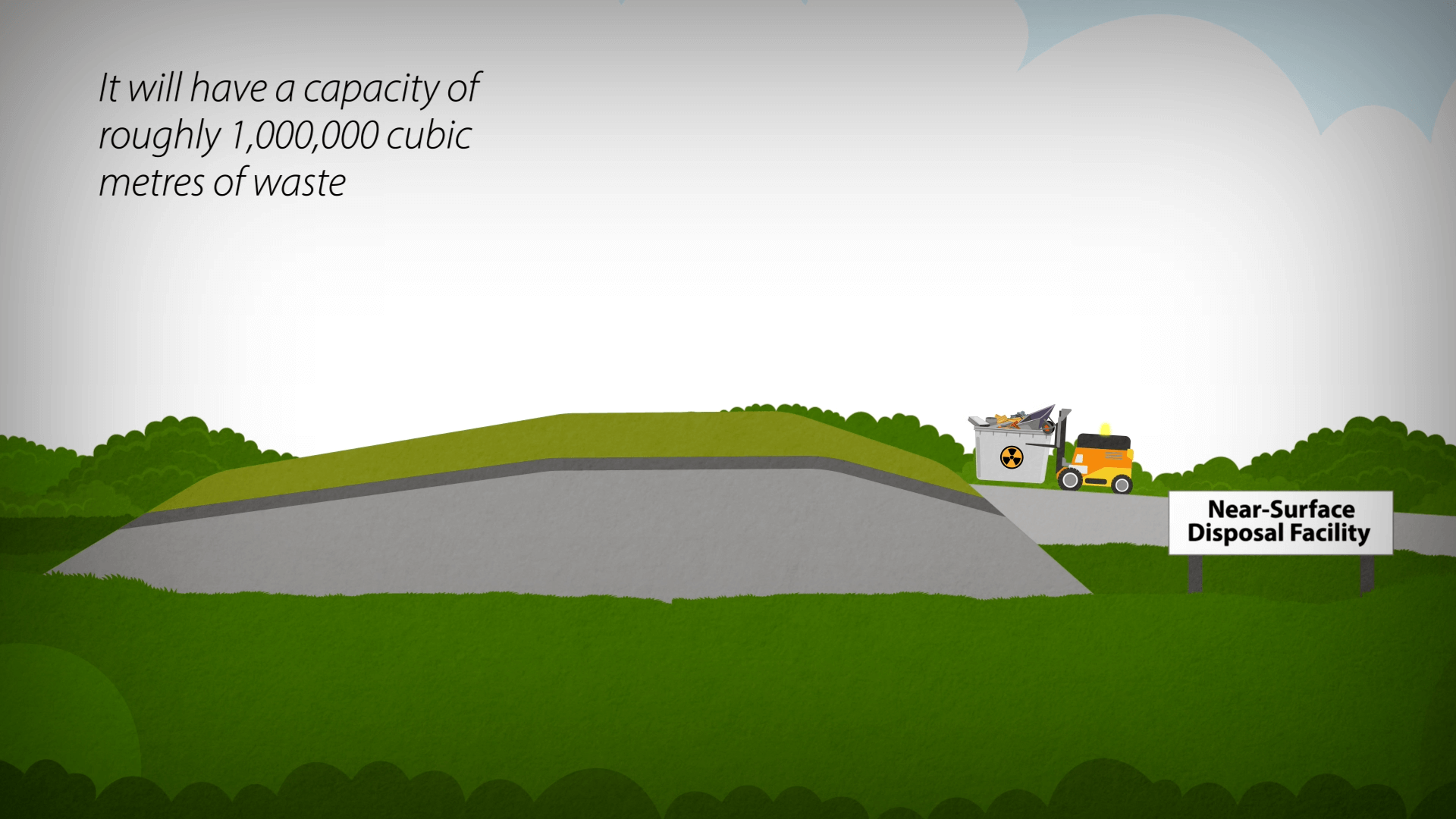
One of the biggest issues with the Near Surface Disposal Facility is right in the name; it is on the surface, and exposed to the elements. In essence, it is a high-tech landfill for dangerous nuclear waste. Although improvements have been made to the proposal to limit the exposure of the waste to precipitation, this will still be an important consideration for the facility if constructed. Therefore, the project requires a wastewater treatment plant to treat any precipitation or runoff exposed to the contained waste.
One of the experts with whom we consulted specifically looked at the plant and how it is planned to be operated. Although the findings were that the treatment process proposed for the plant would function in theory, there were several areas where the proposal seemed weak. It could easily be strengthened to offer better protection for our waterways and drinking water.
The processes outlined in the NSDF proposal are sufficient to the task on paper, however they rely on certain assumptions that may be difficult to control for. The biggest is that they presume that only low level waste will be contained in the mound (more on that later). The process was also only tested on certain types of contaminants. This presents a major issue if the process does not completely work as planned – there is no contingency plan for if levels exceed those anticipated in the design.
The expert we consulted therefore recommends that the project add additional components to the wastewater treatment plant to cover for any unforeseen flaw or miscalculation. Specifically, a process called reverse-osmosis. This is a standard water treatment option around the world and involves well understood technology, albeit it requires additional training and precautions for operators. However, the addition of reverse-osmosis would go a long way to building public trust in the project, especially for those concerned with potential leakage of radioactive material into local water bodies.
Ongoing Monitoring
Our next recommendation is around monitoring for the facility and the site in general. While there is a plan for a monitoring program, we feel that it is not being kept in place for long enough. It should be simple enough for the proposal to be updated to include a more robust monitoring regimen. In addition, monitoring programs must include an independent committee to assess and review the monitoring program so that it remains focused, effective and up to date the duration of monitoring post-closure. All results associated with the oversight and monitoring programs for the NSDF should be made publically accessible.
The expert investigating this issue also has concerns about other types of waste that may be included in the NSDF, and that the monitoring program is not equipped to handle them. While the monitoring obviously focuses on radioactive waste and the risks they pose, there will also very likely be chemical waste included in the waste at the facility. These will be the residue of medical research, and other related projects that have taken place over the history of the Chalk River site. These materials do not break down in the same way that radioactive waste does, and thus may be just as potent – and dangerous – if accidentally released. The monitoring program should therefore include ways to detect these potential pollutants as well, to ensure the safety of all those who use the river.
The Location of the NSDF
Another concern that has long been on our radar, and was also reviewed by one of our experts, is why exactly this location was chosen. Although our expert believes that the project has taken the challenges of the site into account, the question remains on whether there were other options, and how much effort was put into looking into them.
While the location was clearly chosen because of its proximity to the waste that will fill it, the investigation of potential locations was artificially limited to the Chalk River site. This means that the project was forced to confront what our expert describes as “unfavourable geology”, which in turn led to many of the technological solutions to issues that may not have been present at another site. Could a better location have been found if a more expanded investigation had been launched?
Consultation with Indigenous Communities
Algonquin communities in the watershed have asked to be consulted and involved in the process in a meaningful way. There have been requests for a delay in these hearings to allow for this process to take place. Ottawa Riverkeeper would like to reiterate our support for Algonquin communities in the watershed who have asked for meaningful consultations within this decision making process.
Regulation and Oversight
The final concern we want to highlight is also our biggest. It has to do with the regulation in place, and the role of CNSC as the regulator in charge of greenlighting this proposal. We want the CNSC to really do the best job that they can to protect our waterways, and are therefore troubled by some inconsistencies within the proposal that could easily be amended before it is accepted.
Recall that one issue with the effectiveness of the wastewater treatment plant was that it is designed with a number of assumptions about the waste present in the leachate. The criteria for determining what level of waste will be included in the mound remain vague and are therefore somewhat concerning. Although they are technically within the legal standards for Canada, they are at the maximum possible level for those standards. This means any deviation from expected levels would be above what is acceptable. Typically a project like this will take a more conservative standard, to ensure that levels are low enough.
One potential contaminant from the facility will be Tritium. Tritium is a radioactive version of the element hydrogen, and can be easily incorporated into water. Once in water it is impossible to remove. In another example of troubling standards, those for release of Tritium from the facility are currently at the threshold allowed for environmental dumping, not drinking water safety. The effluent from the wastewater treatment plant will be discharged (or released) into Perch Lake, or into an exfiltration area right next to the NSDF. Perch Lake is not a drinking water source, and therefore the rationale for allowing this high threshold is that effluent does not necessitate drinking water standards. However, Perch Lake eventually drains into the Ottawa River, which is a source of drinking water for an estimated 5 million people.
At these hearings we will urge CNSC to review some of these special allowances for the project that do not seem to make sense if the regulator seeks the best possible protections for the Ottawa River.
Conclusion
The NSDF has been in the works for a long time, and as we and the experts we consulted with discovered, the proposal has improved dramatically since the last time it was put forward. However, serious questions pertaining to the protection of our waterways remain, and Ottawa Riverkeeper will be doing all we can to bring these concerns forward on May 30th. We want to hold the regulator, CNSC, accountable and explain how public and environmental safety is being taken into account. We want assurances that the best possible protections for our river, and its residents, are in place should the project move forward.
My objections are legion, however the most fundamental of them, as every Boy Scout knows, is that one does not place a toilet upstream of the water you intend to drink. Ever!
The original foolishness was in selecting Chalk River as a suitable location for a nuclear facility. Everything else, just like the waste we are attempting to deal with, flows from that decision.
It is impossible to support such stupidity and the waste must be removed to an area more compatible with the danger it poses.
The CNSC hearings will be held at the end of this month. This is a crucial time for the Ottawa River and for all life forms in its vast watershed.
The legacy of deadly on-site wastes at Chalk River – and other radioactive materials and toxins that have been shipped from other locations despite advice from many stakeholders – is about to be determined.
The proposed mega dump is above ground. Climate change is wreaking havoc in ways that can never be foreseen by nuclear scientists. The Ottawa River is on a fault line prone to earthquakes. The war in Ukraine clearly highlights (Chernobyl) that nefarious minds do not need atomic bombs, just conventional explosives at a nuclear installation where the spread of radioactive materials would be just as deadly as an atomic bomb.
The development of more nuclear waste, as others have pointed out in previous discussions on this site, when the industry has no internationally acceptable or fail-safe idea of how to dispose of the current amassment of deadly waste in Canada, much less globally, is ensuring that we are on the brink of creating the closing chapters of the Anthropocene age.
Quick and dirty solutions to dump deadly radioactive waste and toxins that make foreign companies rich (including one with questionable track records) is a huge price that the Ottawa River and its inhabitants may well pay for the negligence of our governments and the nuclear industry in Canada. Shame on us. MAD (Mutual Assured Destruction) indeed.