
Posted: May 23, 2023
A small step forward, but not far enough: Canada’s New Radioactive Waste Policy
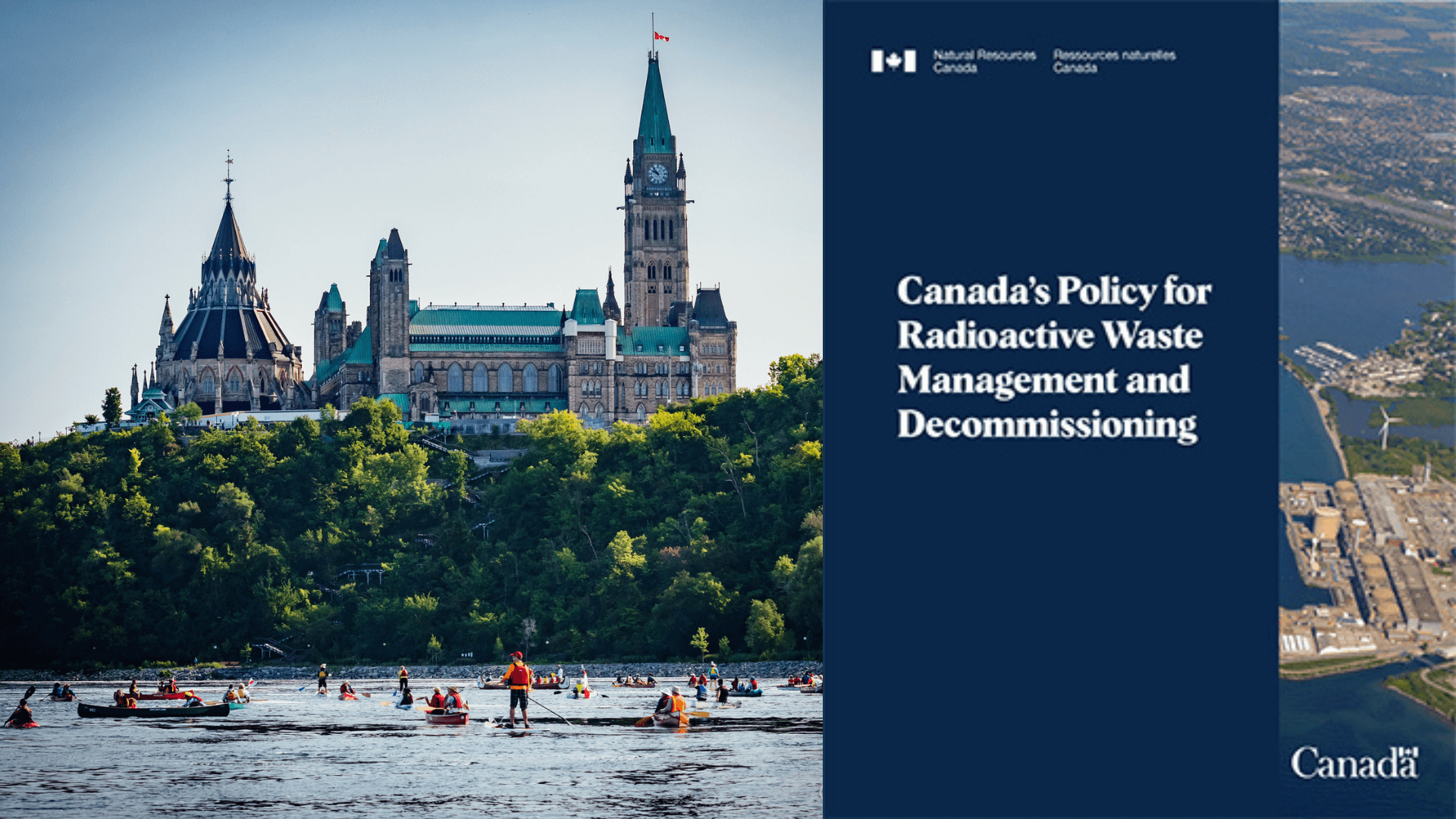
In late March 2023, Natural Resources Canada quietly released the long-awaited final version of the Federal Government’s new Radioactive Waste Policy. While we are glad a Policy has been released, the final document does not match our hopes for what this endeavour might have achieved for water protection.
In 2020, Ottawa Riverkeeper launched a campaign calling for a new Federal Policy on Radioactive Waste. We had identified a significant gap in regulation, one that we felt had led to potential threats to the Ottawa River watershed. This became particularly apparent to us while researching aspects of the long-proposed Near Surface Disposal Facility at Chalk River, which you can read more about here.
The Good News
We are pleased to see that after a long and very determined public consultation process, a new Policy for Radioactive Waste and Decommissioning is now in place. That a policy was put in place where there was previously little regulation is a step forward.
Additionally, the work done on the public consultation was impressive, with tons of information provided so that the public could participate in an informed manner. The final document, What We Heard: Modernizing Canada’s Policy for Radioactive Waste Management and Decommissioning, is incredibly in-depth and outlines very clear requests from the public about the direction the policy should be heading. This was a fantastic exercise in identifying how informed Canadians feel about the issue and where multiple perspectives agree on the need for updated policy.
Throughout the development of the policy, Ottawa Riverkeeper communicated suggestions that we felt would strengthen freshwater protections. As part of the initial public consultation, we proposed 15 recommendations for the policy, and when the Draft policy was released we made an official submission with our comments. We were pleased to learn that our feedback did influence certain parts of the final policy. This echoes NRCan’s desire to listen to the concerns of groups involved with this issue to shape the final policy, and demonstrates the potential to further bolster environmental protections.
All eyes are now on the Integrated Strategy for Radioactive Waste being developed by the Nuclear Waste Management Organization (NWMO), an industry group. The strategy is meant to implement many of the points raised within the Policy and is yet to be finalized.
The Bad News
Unfortunately, there is still a significant gap between the final policy and many of the concerns and recommendations identified in the public consultation process and put forward by Ottawa Riverkeeper and other environmental organizations. Below are several areas where concerns remain.
The first is transparency. While we are glad the policy identifies transparency as important, it does little to actually put in place mechanisms that would build public trust in the regulators and industry organizations involved in this work. This could be greatly improved in various ways, starting with laying out reasonable timelines for review. Additionally, NRCan should take a more active role in what critical information will be provided to the government and the public, as well as mechanisms for how records will be checked and validated. Increased oversight in this aspect and others would be most welcome. Greater transparency would benefit an industry that already struggles with confidence and trust from the public.
There was also hope that the new policy would introduce stronger mechanisms for further reviews. This is especially important given the potentially drastic changes in nuclear technology in the coming years, with much interest from the industry being given to Small Modular Reactors and Micro Modular Reactors, as well as the mention of waste reprocessing within the text of the policy. The policy itself is to be reviewed at least every 10 years but is less clear about the Integrated Strategy for Radioactive Waste. When releasing this policy, NRCan stated “we must keep pace with evolving views and technology development”, and yet when concrete reviews and updates to actual waste management would be required is less clear, as the strategy would only be “reviewed and updated as appropriate upon request from the Minister of Natural Resources”. This is disappointing.
One thing that Ottawa Riverkeeper and others have long argued for is more structured waste classifications. Currently, the industry is able to cherry-pick the classifications that best suit their needs, without regard for which is the most appropriate for public safety and environmental protection. We had hoped that an updated policy would both clearly define these classifications, and also force the industry to adopt the most restrictive thresholds and limits where multiple guidelines overlap. This was not included in the policy, nor is it clearly provided in the Integrated Strategy for Radioactive Waste which goes to greater lengths discussing which waste should be permanently stored where than by providing assurances of how waste classifications will be done.
The policy also does little to outline enforcement mechanisms for any of the rules it is proposing. We would have liked to see strong language around the need to keep the industry accountable to the rules. Unfortunately, this is lacking.
Ongoing dialogues
Despite the shortcomings of the policy, we are pleased that dialogue with concerned groups is continuing. Ottawa Riverkeeper has had the opportunity to meet with representatives from NRCan to discuss the concerns raised above and other missing pieces. This continued engagement should be applauded, and it is our hope that many of the missing elements from the Policy can still be implemented to fully protect Canada’s waterways.
We hope that some of the concerns raised above could be addressed with the Integrated Strategy for Radioactive Waste; as of its current state, this seems unlikely. A draft version was released for review before the policy was finalized, and it does little to assuage our misgivings.
Questions remain about what this means for the future of radioactive waste management in Canada. A policy is now in place where before there was little regulation, which is a step forward. However, there is much ground to cover before we can have confidence that the interests and safety of Canadians and the environment are being fully protected. One step forward, with many more needed.
Thank you for continuing to follow this issue. The idea of that huge radioactive waste dump at Chalk River makes me heartsick. And that the nuclear industry develops policies seems all too much like putting the fox in charge of the hen house!
Keep up the good, critical, work.
Back in the 70s are concerns were overe about how radioactivity of waste last for thousands of years. Cancer rates are not going down. This waste is to be buried in contained and sealed under hard rock.