About Ottawa
Riverkeeper
What is a
Watershed?
What does a healthy
watershed look like?

Presenting
Sponsor
About Ottawa
Riverkeeper
Ottawa Riverkeeper, a charitable organisation, is a champion and collective voice for the Ottawa River watershed, providing leadership and inspiration to protect, promote and improve its ecological health and future.
Guided by a science-based approach, we provide clear information with the aim to engage the public and empower citizens and decision-makers, and inspire cooperative action focused toward ensuring clean, healthy, and accessible water for all people and species.
Learn more at ottawariverkeeper.ca!
What is a
Watershed?
A watershed, also known as a catchment or drainage basin, is simply all of the land and waterways that drain towards a single location. Here is another way to think about it: imagine a bathtub. As you add water to the bathtub, no matter where it falls within the bathtub it will eventually flow towards the drain. In a watershed, if water is poured onto the land (such as rainfall), it will eventually flow into a certain body of water (either directly, or via smaller tributaries). That area of land is then part of that body of water’s watershed.
Every body of water has a watershed, and can in turn be part of another watershed. For example, the area of land that drains into the Gatineau River makes up the Gatineau River watershed. The Gatineau River drains into the Ottawa River though, so all that land is also part of the Ottawa River watershed. The Gatineau River watershed is therefore considered a sub-watershed of the Ottawa River watershed. The Ottawa River watershed contains several large subwatersheds, and in turn is itself a subwatershed of the St Lawrence River watershed.
A watershed can have many different types of land cover. Forests, wetlands, waterbodies, cities, towns and other developed areas, and agricultural lands are all examples of land cover. The land cover present in a watershed can have an impact on the rivers within it by changing how quickly rainfall moves over the land. Plus, if there are pollutants, nutrients, or sediment, these might be transported to local streams and impact the river’s water quality. Everything within a watershed is connected; what happens in one area can have big impacts on the others.
What does a healthy
watershed look like?
A healthy watershed is one where humans and nature live in balance. That means native species thrive, and their habitat remains intact, even alongside human habitation.
There are many interconnected factors that influence the ecological health of a river and its watershed. For example, for every watershed there will be normal, healthy ranges of water temperatures, flow volumes and rates, nutrient concentrations, as well as populations of native species. If conditions shift outside of their healthy ranges, or if there is pollution or the introduction of new species, that balance can be disrupted and change the health of the watershed. However, in a system as large and complex as the Ottawa River watershed, there is so much natural variation geographically, temporally, and seasonally, that determining whether the watershed as a whole is healthy or not is a difficult puzzle to solve. If there is pollution in the lower half of the river, but the areas upstream are still clean, is the whole watershed unhealthy? Does the presence of an invasive species in one area change the entire watershed as a whole? The answers to these questions, unfortunately, are not straightforward, but if we can detect and address issues quickly, we can protect other areas. By doing this, we can improve the overall health of the watershed.
This is why Ottawa Riverkeeper is working on a Watershed Health Assessment and Monitoring project. By working with experts, academic researchers, Algonquin communities, and volunteer citizen scientists, this ongoing project aims to collect and analyse data, and share what we learn with you as well as decision-makers. The data collection is focused on 14 indicators of aquatic ecosystem health, and collected throughout the watershed. By working together with lots of different groups and people, and by creating accessible educational tools like this discovery portal, we hope to inspire and empower citizens of the watershed to learn more about the health of the watershed and take actions to protect the incredible Ottawa River.
Presenting
Sponsor
Ottawa Riverkeeper’s Discovery Portal is presented by RBC.
Ottawa Riverkeeper would like to thank the generous support of RBC for making the Discovery Portal possible.
Additional funding for the Watershed Health Assessment and Monitoring initiative comes from:


Visit our website for more information about our partners and funding.
Are native fish populations thriving in the Ottawa River watershed?
In a river as long as the Ottawa River, it should be no surprise that there is an impressive diversity of fish species. Water, land, and shore conditions can be very different from one area to another, which makes for a wide variety of habitats for different species to thrive in. In some cases, those changes in habitat from one reach to the next are natural, such as narrow, shallow rapids compared to wider, deeper, slow moving sections and bays, or small streams where temperature can vary dramatically with the seasons. However, habitats can also be changed by pollution, climate change, shoreline denaturalization, invasive species, and fragmentation (such as dams or other human-made barriers). These new or altered habitats can impact native fish populations by restricting access to habitat or changing water quality and flow or by reducing access to or availability of food all of which contribute to the declines that some native fish populations may be facing.
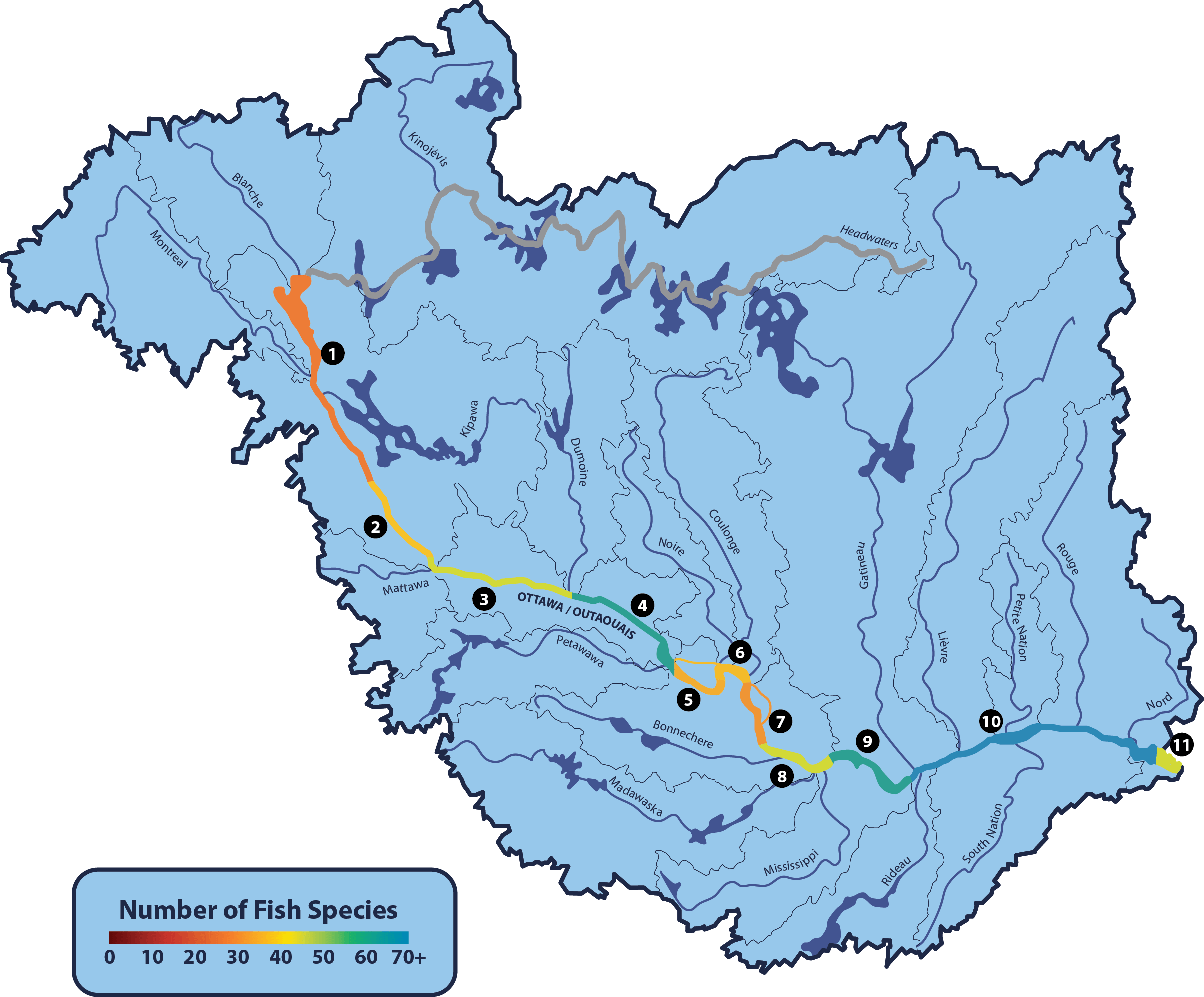
Common species or groups of species
(27 species)
(38 species)
(45 species)
(62 species)
(35 species)
(37 species)
(31 species)
(45 species)
(61 species)
(72 species)
(42 species)
1 Lake Temiskaming
(27 species)
- Lake Sturgeon
(Acipenser fulvescens) - Longnose Sucker
(Catostomus catostomus) - Common White Sucker
(Catostomus commersoni) - Shorthead Redhorse
(Moxostoma macrolepidotum) - River Redhorse
(Moxostoma carinatum) - Rock Bass
(Ambloplites rupestris) - Smallmouth Bass
(Micropterus dolomieu) - Common Shiner
(Luxilus cornutus) - Creek Chub
(Semotilus atromaculatus) - Fallfish
(Semotilus corporalis) - Northern Pike
(Esox lucius) - Goldeye
(Hiodon alosoides) - Mooneye
(Hiodon tergisus) - Brown Bullhead
(Ameiurus nebulosus) - Emerald Shiner
(Notropis atherinoides) - Spottail Shiner
(Notropis hudsonius) - Burbot
(Lota lota) - Rainbow Smelt
(Osmerus mordax) - Yellow Perch
(Perca flavescens) - Logperch
(Percina caprodes) - Sauger
(Stizostedion canadense) - Walleye
(Stizostedion vitreum) - Trout-Perch
(Percopsis omiscomaycus) - Lake Whitefish
(Coregonus clupeaformis) - Cisco
(Coregonus artedi) - Lake Trout
(Salvelinus namaycush) - Freshwater Drum
(Aplodinotus grunniens)
2 Lac la Cave
(38 species)
- Lake Sturgeon
(Acipenser fulvescens) - Longnose Sucker
(Catostomus catostomus) - Common White Sucker
(Catostomus commersoni) - Shorthead Redhorse
(Moxostoma macrolepidotum) - Rock Bass
(Ambloplites rupestris) - Smallmouth Bass
(Micropterus dolomieu) - Slimy Sculpin
(Cottus cognatus) - Common Shiner
(Luxilus cornutus) - Hornyhead Chub**
(Nocomis biguttatus) - Golden Shiner
(Notemigonus crysoleucas) - Bluntnose Minnow
(Pimephales notatus) - Fathead Minnow
(Pimephales promelas) - Creek Chub
(Semotilus atromaculatus) - Fallfish
(Semotilus corporalis) - Pearl Dace
(Semotilus margarita) - Northern Pike
(Esox lucius) - Muskellunge*
(Esox masquinongy) - Brook Stickleback
(Culaea inconstans) - Goldeye
(Hiodon alosoides) - Mooneye
(Hiodon tergisus) - Longnose Gar
(Lepisosteus oculatus) - Lake Chub
(Couesius plumbeus) - Emerald Shiner
(Notropis atherinoides) - Spottail Shiner
(Notropis hudsonius) - Northern Redbelly Dace
(Phoxinus eos) - Finescale Dace
(Phoxinus neogaeus) - Burbot
(Lota lota) - Johnny Darter
(Etheostoma nigrum) - Yellow Perch
(Perca flavescens) - Logperch
(Percina caprodes) - Sauger
(Stizostedion canadense) - Walleye
(Stizostedion vitreum) - Trout-Perch
(Percopsis omiscomaycus) - Lake Whitefish
(Coregonus clupeaformis) - Cisco
(Coregonus artedi) - Brook Trout
(Salvelinus fontinalis) - Lake Trout*
(Salvelinus namaycush) - Freshwater Drum
(Aplodinotus grunniens)
3 Holden Lake
(45 species)
- Lake Sturgeon
(Acipenser fulvescens) - Longnose Sucker
(Catostomus catostomus) - Common White Sucker
(Catostomus commersoni) - Silver Redhorse
(Moxostoma anisurum) - Shorthead Redhorse
(Moxostoma macrolepidotum) - Greater Redhorse
(Moxostoma valenciennesi) - River Redhorse
(Moxostoma carinatum) - Rock Bass
(Ambloplites rupestris) - Pumpkinseed
(Lepomis gibbosus) - Bluegill*
(Lepomis macrochirus) - Smallmouth Bass
(Micropterus dolomieu) - Common Shiner
(Luxilus cornutus) - Bluntnose Minnow
(Pimephales notatus) - Fathead Minnow
(Pimephales promelas) - Creek Chub
(Semotilus atromaculatus) - Fallfish
(Semotilus corporalis) - Pearl Dace
(Semotilus margarita) - Northern Pike
(Esox lucius) - Muskellunge
(Esox masquinongy) - Brook Stickleback
(Culaea inconstans) - Goldeye
(Hiodon alosoides) - Mooneye
(Hiodon tergisus) - Brown Bullhead
(Ameiurus nebulosus) - Channel Catfish
(Ictalurus punctatus) - Blacknose Shiner
(Notropis heterolepis) - Emerald Shiner
(Notropis atherinoides) - Blackchin Shiner
(Notropis heterodon) - Spottail Shiner
(Notropis hudsonius) - Rosyface Shiner
(Notropis rubellus) - Mimic Shiner
(Notropis volucellus) - Finescale Dace
(Phoxinus neogaeus) - Blacknose Dace
(Rhinichthys atratulus) - Longnose Dace
(Rhinichthys cataractae) - Burbot
(Lota lota) - Iowa Darter
(Etheostoma exile) - Johnny Darter
(Etheostoma nigrum) - Yellow Perch
(Perca flavescens) - Logperch
(Percina caprodes) - Sauger
(Stizostedion canadense) - Walleye
(Stizostedion vitreum) - Trout-Perch
(Percopsis omiscomaycus) - Lake Whitefish
(Coregonus clupeaformis) - Cisco
(Coregonus artedi) - Lake Trout
(Salvelinus namaycush)
4 Allumette Lake - upper
(62 species)
- Lake Sturgeon
(Acipenser fulvescens) - American Eel*
(Anguilla rostrata) - Longnose Sucker
(Catostomus catostomus) - Common White Sucker
(Catostomus commersoni) - Silver Redhorse
(Moxostoma anisurum) - Shorthead Redhorse
(Moxostoma macrolepidotum) - Greater Redhorse
(Moxostoma valenciennesi) - River Redhorse
(Moxostoma carinatum) - Rock Bass
(Ambloplites rupestris) - Pumpkinseed
(Lepomis gibbosus) - Smallmouth Bass
(Micropterus dolomieu) - Largemouth Bass
(Micropterus salmoides) - Black Crappie
(Pomoxis nigromaculatus) - Mottled Sculpin
(Cottus bairdi) - Slimy Sculpin
(Cottus cognatus) - Common Shiner
(Luxilus cornutus) - Golden Shiner
(Notemigonus crysoleucas) - Bluntnose Minnow
(Pimephales notatus) - Fathead Minnow
(Pimephales promelas) - Creek Chub
(Semotilus atromaculatus) - Fallfish
(Semotilus corporalis) - Pearl Dace
(Semotilus margarita) - Northern Pike
(Esox lucius) - Muskellunge
(Esox masquinongy) - Banded Killifish
(Fundulus diaphanus) - Brook Stickleback
(Culaea inconstans) - Threespine Stickleback**
(Gasterosteus aculeatus) - Ninespine Stickleback
(Pungitius pungitius) - Mooneye
(Hiodon tergisus) - Yellow Bullhead
(Ameiurus natalis) - Brown Bullhead
(Ameiurus nebulosus) - Channel Catfish
(Ictalurus punctatus) - Longnose Gar
(Lepisosteus oculatus) - Brassy Minnow
(Hybognathus hankinsoni) - Blacknose Shiner
(Notropis heterolepis) - Emerald Shiner
(Notropis atherinoides) - Blackchin Shiner
(Notropis heterodon) - Spottail Shiner
(Notropis hudsonius) - Rosyface Shiner
(Notropis rubellus) - Sand Shiner
(Notropis stramineus) - Mimic Shiner
(Notropis volucellus) - Northern Redbelly Dace
(Phoxinus eos) - Finescale Dace
(Phoxinus neogaeus) - Blacknose Dace
(Rhinichthys atratulus) - Longnose Dace
(Rhinichthys cataractae) - Burbot
(Lota lota) - Rainbow Smelt
(Osmerus mordax) - Iowa Darter
(Etheostoma exile) - Johnny Darter
(Etheostoma nigrum) - Tessellated Darter
(Etheostoma olmstedi) - Yellow Perch
(Perca flavescens) - Logperch
(Percina caprodes) - Sauger
(Stizostedion canadense) - Walleye
(Stizostedion vitreum) - Trout-Perch
(Percopsis omiscomaycus) - Northern Brook Lamprey
(Ichthyomyzon fossor) - Lake Whitefish
(Coregonus clupeaformis) - Cisco
(Coregonus artedi) - Brook Trout
(Salvelinus fontinalis) - Lake Trout
(Salvelinus namaycush) - Freshwater Drum
(Aplodinotus grunniens) - Central Mudminnow
(Umbra limi)
5 Allumette Lake - lower
(35 species)
- Lake Sturgeon
(Acipenser fulvescens) - American Eel*
(Anguilla rostrata) - Common White Sucker
(Catostomus commersoni) - Silver Redhorse
(Moxostoma anisurum) - Shorthead Redhorse
(Moxostoma macrolepidotum) - River Redhorse
(Moxostoma carinatum) - Rock Bass
(Ambloplites rupestris) - Pumpkinseed
(Lepomis gibbosus) - Smallmouth Bass
(Micropterus dolomieu) - Largemouth Bass
(Micropterus salmoides) - Black Crappie
(Pomoxis nigromaculatus) - Golden Shiner
(Notemigonus crysoleucas) - Fallfish
(Semotilus corporalis) - Northern Pike
(Esox lucius) - Muskellunge
(Esox masquinongy) - Mooneye
(Hiodon tergisus) - Yellow Bullhead
(Ameiurus natalis) - Brown Bullhead
(Ameiurus nebulosus) - Channel Catfish
(Ictalurus punctatus) - Longnose Gar
(Lepisosteus oculatus) - Blacknose Shiner
(Notropis heterolepis) - Emerald Shiner
(Notropis atherinoides) - Blackchin Shiner
(Notropis heterodon) - Spottail Shiner
(Notropis hudsonius) - Rosyface Shiner
(Notropis rubellus) - Burbot
(Lota lota) - Rainbow Smelt
(Osmerus mordax) - Johnny Darter
(Etheostoma nigrum) - Yellow Perch
(Perca flavescens) - Logperch
(Percina caprodes) - Sauger
(Stizostedion canadense) - Walleye
(Stizostedion vitreum) - Trout-Perch
(Percopsis omiscomaycus) - Lake Whitefish
(Coregonus clupeaformis) - Cisco
(Coregonus artedi)
6 Lac Coulonge
(37 species)
- Lake Sturgeon
(Acipenser fulvescens) - American Eel*
(Anguilla rostrata) - Common White Sucker
(Catostomus commersoni) - Silver Redhorse
(Moxostoma anisurum) - Shorthead Redhorse
(Moxostoma macrolepidotum) - River Redhorse
(Moxostoma carinatum) - Rock Bass
(Ambloplites rupestris) - Pumpkinseed
(Lepomis gibbosus) - Smallmouth Bass
(Micropterus dolomieu) - Largemouth Bass
(Micropterus salmoides) - Black Crappie
(Pomoxis nigromaculatus) - Slimy Sculpin
(Cottus cognatus) - Golden Shiner
(Notemigonus crysoleucas) - Bluntnose Minnow
(Pimephales notatus) - Fathead Minnow
(Pimephales promelas) - Fallfish
(Semotilus corporalis) - Pearl Dace
(Semotilus margarita) - Northern Pike
(Esox lucius) - Muskellunge
(Esox masquinongy) - Mooneye
(Hiodon tergisus) - Yellow Bullhead
(Ameiurus natalis) - Brown Bullhead
(Ameiurus nebulosus) - Channel Catfish
(Ictalurus punctatus) - Longnose Gar
(Lepisosteus oculatus) - Emerald Shiner
(Notropis atherinoides) - Blackchin Shiner
(Notropis heterodon) - Rosyface Shiner
(Notropis rubellus) - Burbot
(Lota lota) - Rainbow Smelt
(Osmerus mordax) - Johnny Darter
(Etheostoma nigrum) - Yellow Perch
(Perca flavescens) - Logperch
(Percina caprodes) - Sauger
(Stizostedion canadense) - Walleye
(Stizostedion vitreum) - Lake Whitefish
(Coregonus clupeaformis) - Cisco
(Coregonus artedi) - Central Mudminnow
(Umbra limi)
7 Lac du Rocher Fendu
(31 species)
- Lake Sturgeon
(Acipenser fulvescens) - American Eel
(Anguilla rostrata) - Common White Sucker
(Catostomus commersoni) - Silver Redhorse
(Moxostoma anisurum) - Shorthead Redhorse
(Moxostoma macrolepidotum) - River Redhorse
(Moxostoma carinatum) - Rock Bass
(Ambloplites rupestris) - Pumpkinseed
(Lepomis gibbosus) - Smallmouth Bass
(Micropterus dolomieu) - Largemouth Bass
(Micropterus salmoides) - Northern Pike
(Esox lucius) - Muskellunge
(Esox masquinongy) - Brook Stickleback
(Culaea inconstans) - Mooneye
(Hiodon tergisus) - Yellow Bullhead
(Ameiurus natalis) - Brown Bullhead
(Ameiurus nebulosus) - Channel Catfish
(Ictalurus punctatus) - Longnose Gar
(Lepisosteus oculatus) - Emerald Shiner
(Notropis atherinoides) - Blackchin Shiner
(Notropis heterodon) - Rosyface Shiner
(Notropis rubellus) - Burbot
(Lota lota) - Johnny Darter
(Etheostoma nigrum) - Yellow Perch
(Perca flavescens) - Sauger
(Stizostedion canadense) - Walleye
(Stizostedion vitreum) - Trout-Perch
(Percopsis omiscomaycus) - Cisco
(Coregonus artedi) - Lake Trout
(Salvelinus namaycush) - Freshwater Drum
(Aplodinotus grunniens)
8 Lac des Chats
(45 species)
- Lake Sturgeon
(Acipenser fulvescens) - American Eel
(Anguilla rostrata) - Longnose Sucker
(Catostomus catostomus) - Common White Sucker
(Catostomus commersoni) - Silver Redhorse
(Moxostoma anisurum) - Shorthead Redhorse
(Moxostoma macrolepidotum) - Greater Redhorse
(Moxostoma valenciennesi) - River Redhorse
(Moxostoma carinatum) - Rock Bass
(Ambloplites rupestris) - Pumpkinseed
(Lepomis gibbosus) - Bluegill
(Lepomis macrochirus) - Smallmouth Bass
(Micropterus dolomieu) - Largemouth Bass
(Micropterus salmoides) - Black Crappie
(Pomoxis nigromaculatus) - Golden Shiner
(Notemigonus crysoleucas) - Bluntnose Minnow
(Pimephales notatus) - Creek Chub
(Semotilus atromaculatus) - Fallfish
(Semotilus corporalis) - Northern Pike
(Esox lucius) - Muskellunge
(Esox masquinongy) - Banded Killifish
(Fundulus diaphanus) - Goldeye
(Hiodon alosoides) - Mooneye
(Hiodon tergisus) - Yellow Bullhead
(Ameiurus natalis) - Brown Bullhead
(Ameiurus nebulosus) - Channel Catfish
(Ictalurus punctatus) - Longnose Gar
(Lepisosteus oculatus) - Blacknose Shiner
(Notropis heterolepis) - Emerald Shiner
(Notropis atherinoides) - Blackchin Shiner
(Notropis heterodon) - Spottail Shiner
(Notropis hudsonius) - Rosyface Shiner
(Notropis rubellus) - Mimic Shiner
(Notropis volucellus) - Blacknose Dace
(Rhinichthys atratulus) - Burbot
(Lota lota) - Iowa Darter
(Etheostoma exile) - Johnny Darter
(Etheostoma nigrum) - Yellow Perch
(Perca flavescens) - Logperch
(Percina caprodes) - Sauger
(Stizostedion canadense) - Walleye
(Stizostedion vitreum) - Silver Lamprey*
(Ichthyomyzon unicuspis) - Lake Whitefish
(Coregonus clupeaformis) - Lake Trout
(Salvelinus namaycush) - Freshwater Drum
(Aplodinotus grunniens)
9 Lac Deschenes
(61 species)
- Lake Sturgeon
(Acipenser fulvescens) - American Eel
(Anguilla rostrata) - Longnose Sucker
(Catostomus catostomus) - Common White Sucker
(Catostomus commersoni) - Silver Redhorse
(Moxostoma anisurum) - Shorthead Redhorse
(Moxostoma macrolepidotum) - River Redhorse
(Moxostoma carinatum) - Rock Bass
(Ambloplites rupestris) - Pumpkinseed
(Lepomis gibbosus) - Bluegill
(Lepomis macrochirus) - Smallmouth Bass
(Micropterus dolomieu) - Largemouth Bass
(Micropterus salmoides) - White Crappie
(Pomoxis annularis) - Black Crappie
(Pomoxis nigromaculatus) - Mottled Sculpin
(Cottus bairdi) - Slimy Sculpin
(Cottus cognatus) - Common Shiner
(Luxilus cornutus) - Golden Shiner
(Notemigonus crysoleucas) - Bluntnose Minnow
(Pimephales notatus) - Fathead Minnow
(Pimephales promelas) - Creek Chub
(Semotilus atromaculatus) - Fallfish
(Semotilus corporalis) - Pearl Dace
(Semotilus margarita) - Northern Pike
(Esox lucius) - Muskellunge
(Esox masquinongy) - Banded Killifish
(Fundulus diaphanus) - Brook Stickleback
(Culaea inconstans) - Ninespine Stickleback
(Pungitius pungitius) - Mooneye
(Hiodon tergisus) - Yellow Bullhead
(Ameiurus natalis) - Brown Bullhead
(Ameiurus nebulosus) - Black Bullhead**
(Ictalurus melas) - Channel Catfish
(Ictalurus punctatus) - Tadpole Madtom
(Noturus gyrinus) - Longnose Gar
(Lepisosteus oculatus) - Eastern Silvery Minnow
(Hybognathus regius) - Blacknose Shiner
(Notropis heterolepis) - Emerald Shiner
(Notropis atherinoides) - Blackchin Shiner
(Notropis heterodon) - Spottail Shiner
(Notropis hudsonius) - Rosyface Shiner
(Notropis rubellus) - Sand Shiner
(Notropis stramineus) - Mimic Shiner
(Notropis volucellus) - Northern Redbelly Dace
(Phoxinus eos) - Longnose Dace
(Rhinichthys cataractae) - Burbot
(Lota lota) - Rainbow Smelt
(Osmerus mordax) - Iowa Darter
(Etheostoma exile) - Johnny Darter
(Etheostoma nigrum) - Tessellated Darter
(Etheostoma olmstedi) - Yellow Perch
(Perca flavescens) - Logperch
(Percina caprodes) - Channel Darter
(Percina copelandi) - Sauger
(Stizostedion canadense) - Walleye
(Stizostedion vitreum) - Trout-Perch
(Percopsis omiscomaycus) - Northern Brook Lamprey
(Ichthyomyzon fossor) - Silver Lamprey
(Ichthyomyzon unicuspis) - Cisco
(Coregonus artedi) - Freshwater Drum
(Aplodinotus grunniens) - Central Mudminnow
(Umbra limi)
10 Lac Dollard des Ormeaux
(72 species)
- Lake Sturgeon
(Acipenser fulvescens) - American Eel
(Anguilla rostrata) - Brook Silverside
(Labidesthes sicculus) - Quillback
(Carpiodes cyprinus) - Longnose Sucker
(Catostomus catostomus) - Common White Sucker
(Catostomus commersoni) - Silver Redhorse
(Moxostoma anisurum) - Shorthead Redhorse
(Moxostoma macrolepidotum) - Greater Redhorse
(Moxostoma valenciennesi) - River Redhorse
(Moxostoma carinatum) - Rock Bass
(Ambloplites rupestris) - Pumpkinseed
(Lepomis gibbosus) - Bluegill
(Lepomis macrochirus) - Longear Sunfish**
(Lepomis magalotis) - Smallmouth Bass
(Micropterus dolomieu) - Largemouth Bass
(Micropterus salmoides) - White Crappie
(Pomoxis annularis) - Black Crappie
(Pomoxis nigromaculatus) - Mottled Sculpin
(Cottus bairdi) - Common Shiner
(Luxilus cornutus) - Golden Shiner
(Notemigonus crysoleucas) - Bluntnose Minnow
(Pimephales notatus) - Fathead Minnow
(Pimephales promelas) - Creek Chub
(Semotilus atromaculatus) - Fallfish
(Semotilus corporalis) - Pearl Dace
(Semotilus margarita) - Northern Pike
(Esox lucius) - Muskellunge
(Esox masquinongy) - Banded Killifish
(Fundulus diaphanus) - Brook Stickleback
(Culaea inconstans) - Ninespine Stickleback
(Pungitius pungitius) - Mooneye
(Hiodon tergisus) - Yellow Bullhead
(Ameiurus natalis) - Brown Bullhead
(Ameiurus nebulosus) - Channel Catfish
(Ictalurus punctatus) - Stonecat**
(Noturus flavus) - Tadpole Madtom
(Noturus gyrinus) - Margined Madtom**
(Noturus insignis) - Longnose Gar
(Lepisosteus oculatus) - Cutlips Minnow**
(Exoglossum maxillingua) - Brassy Minnow
(Hybognathus hankinsoni) - Eastern Silvery Minnow
(Hybognathus regius) - Emerald Shiner
(Notropis atherinoides) - Bridle Shiner
(Notropis bifrenatus) - Blackchin Shiner
(Notropis heterodon) - Spottail Shiner
(Notropis hudsonius) - Rosyface Shiner
(Notropis rubellus) - Spotfin Shiner**
(Notropis spilopterus) - Mimic Shiner
(Notropis volucellus) - Northern Redbelly Dace
(Phoxinus eos) - Finescale Dace
(Phoxinus neogaeus) - Blacknose Dace
(Rhinichthys atratulus) - Longnose Dace
(Rhinichthys cataractae) - Burbot
(Lota lota) - White Perch
(Morone americana) - Rainbow Smelt
(Osmerus mordax) - Iowa Darter
(Etheostoma exile) - Fantail Darter**
(Etheostoma flabellare) - Johnny Darter
(Etheostoma nigrum) - Tessellated Darter
(Etheostoma olmstedi) - Yellow Perch
(Perca flavescens) - Logperch
(Percina caprodes) - Channel Darter
(Percina copelandi) - Sauger
(Stizostedion canadense) - Walleye
(Stizostedion vitreum) - Trout-Perch
(Percopsis omiscomaycus) - Northern Brook Lamprey
(Ichthyomyzon fossor) - Silver Lamprey
(Ichthyomyzon unicuspis) - American Brook Lamprey**
(Lampetra appendix) - Cisco
(Coregonus artedi) - Freshwater Drum
(Aplodinotus grunniens) - Central Mudminnow
(Umbra limi)
11 Lac des Deux Montagnes
(42 species)
- Lake Sturgeon
(Acipenser fulvescens) - Bowfin**
(Amia calva) - American Eel
(Anguilla rostrata) - Brook Silverside
(Labidesthes sicculus) - Quillback
(Carpiodes cyprinus) - Common White Sucker
(Catostomus commersoni) - Silver Redhorse
(Moxostoma anisurum) - Shorthead Redhorse
(Moxostoma macrolepidotum) - Greater Redhorse
(Moxostoma valenciennesi) - River Redhorse
(Moxostoma carinatum) - Rock Bass
(Ambloplites rupestris) - Pumpkinseed
(Lepomis gibbosus) - Bluegill
(Lepomis macrochirus) - Smallmouth Bass
(Micropterus dolomieu) - Largemouth Bass
(Micropterus salmoides) - Black Crappie
(Pomoxis nigromaculatus) - American Shad
(Alosa sapidissima) - Golden Shiner
(Notemigonus crysoleucas) - Bluntnose Minnow
(Pimephales notatus) - Creek Chub
(Semotilus atromaculatus) - Northern Pike
(Esox lucius) - Muskellunge
(Esox masquinongy) - Banded Killifish
(Fundulus diaphanus) - Brook Stickleback
(Culaea inconstans) - Mooneye
(Hiodon tergisus) - Brown Bullhead
(Ameiurus nebulosus) - Channel Catfish
(Ictalurus punctatus) - Longnose Gar
(Lepisosteus oculatus) - Bridle Shiner
(Notropis bifrenatus) - Spottail Shiner
(Notropis hudsonius) - Burbot
(Lota lota) - White Perch
(Morone americana) - Iowa Darter
(Etheostoma exile) - Johnny Darter
(Etheostoma nigrum) - Yellow Perch
(Perca flavescens) - Sauger
(Stizostedion canadense) - Walleye
(Stizostedion vitreum) - Trout-Perch
(Percopsis omiscomaycus) - Northern Brook Lamprey
(Ichthyomyzon fossor) - Atlantic Salmon**
(Salmo salar) - Freshwater Drum
(Aplodinotus grunniens) - Central Mudminnow
(Umbra limi)
Role of fragmentation
One of the biggest threats to wildlife populations is the fragmentation of habitats due to human infrastructure, and fish are no exception. Habitat fragmentation occurs when a barrier is introduced which reduces the animal’s ability to move from one area to another. For fish and other river species, that is typically in the form of dams in larger rivers, or culverts in smaller creeks and streams. An impassable barrier can restrict population mixing and restrict genetic diversity, which can have long term impacts on the species. An inability for related individuals to access new areas can cause an increase in inbreeding leading to an increase in genetic defects. Without sufficient genetic diversity, a species may be unable to adapt to new environmental challenges. Furthermore, without the proper infrastructure such as species-specific passages like eel ladders, dams restrict or even completely interrupt migratory routes of some species and can be fatal for animals that attempt passing through. One such example is the American eel and their migratory route interrupted near the mouth of the river by Carillon Dam. Once one of the most abundant fish species in the Ottawa River, the American eel population has declined by 99% over the past 40 years, and have been listed as an endangered species in Ontario since 2008. Hydroelectric dams often present an insurmountable obstacle to migration between their maturation habitat in freshwater rivers (such as the Ottawa River) and their breeding grounds in the Sargasso Sea.
Fragmentation of habitat can also indirectly impact fish, as these barriers may impact food availability. If, for example, changes in flow conditions can alter the type of food available. In addition, if fish are used to accessing different parts of the river for different types of food, barriers will also impact the food available. One example are benthic invertebrates that cannot move large distances. Furthermore, the dangers of pollution in fragmented habitats can result in fish being unable to swim away to a new, non-polluted area, and, depending on the type of barrier, the pollution may not be able to disperse and dilute the same way that it would in an open river system.
Additional Resources:
Related indicators of watershed health:
Pick your next topic to explore: