About Ottawa
Riverkeeper
What is a
Watershed?
What does a healthy
watershed look like?

Presenting
Sponsor
About Ottawa
Riverkeeper
Ottawa Riverkeeper, a charitable organisation, is a champion and collective voice for the Ottawa River watershed, providing leadership and inspiration to protect, promote and improve its ecological health and future.
Guided by a science-based approach, we provide clear information with the aim to engage the public and empower citizens and decision-makers, and inspire cooperative action focused toward ensuring clean, healthy, and accessible water for all people and species.
Learn more at ottawariverkeeper.ca!
What is a
Watershed?
A watershed, also known as a catchment or drainage basin, is simply all of the land and waterways that drain towards a single location. Here is another way to think about it: imagine a bathtub. As you add water to the bathtub, no matter where it falls within the bathtub it will eventually flow towards the drain. In a watershed, if water is poured onto the land (such as rainfall), it will eventually flow into a certain body of water (either directly, or via smaller tributaries). That area of land is then part of that body of water’s watershed.
Every body of water has a watershed, and can in turn be part of another watershed. For example, the area of land that drains into the Gatineau River makes up the Gatineau River watershed. The Gatineau River drains into the Ottawa River though, so all that land is also part of the Ottawa River watershed. The Gatineau River watershed is therefore considered a sub-watershed of the Ottawa River watershed. The Ottawa River watershed contains several large subwatersheds, and in turn is itself a subwatershed of the St Lawrence River watershed.
A watershed can have many different types of land cover. Forests, wetlands, waterbodies, cities, towns and other developed areas, and agricultural lands are all examples of land cover. The land cover present in a watershed can have an impact on the rivers within it by changing how quickly rainfall moves over the land. Plus, if there are pollutants, nutrients, or sediment, these might be transported to local streams and impact the river’s water quality. Everything within a watershed is connected; what happens in one area can have big impacts on the others.
What does a healthy
watershed look like?
A healthy watershed is one where humans and nature live in balance. That means native species thrive, and their habitat remains intact, even alongside human habitation.
There are many interconnected factors that influence the ecological health of a river and its watershed. For example, for every watershed there will be normal, healthy ranges of water temperatures, flow volumes and rates, nutrient concentrations, as well as populations of native species. If conditions shift outside of their healthy ranges, or if there is pollution or the introduction of new species, that balance can be disrupted and change the health of the watershed. However, in a system as large and complex as the Ottawa River watershed, there is so much natural variation geographically, temporally, and seasonally, that determining whether the watershed as a whole is healthy or not is a difficult puzzle to solve. If there is pollution in the lower half of the river, but the areas upstream are still clean, is the whole watershed unhealthy? Does the presence of an invasive species in one area change the entire watershed as a whole? The answers to these questions, unfortunately, are not straightforward, but if we can detect and address issues quickly, we can protect other areas. By doing this, we can improve the overall health of the watershed.
This is why Ottawa Riverkeeper is working on a Watershed Health Assessment and Monitoring project. By working with experts, academic researchers, Algonquin communities, and volunteer citizen scientists, this ongoing project aims to collect and analyse data, and share what we learn with you as well as decision-makers. The data collection is focused on 14 indicators of aquatic ecosystem health, and collected throughout the watershed. By working together with lots of different groups and people, and by creating accessible educational tools like this discovery portal, we hope to inspire and empower citizens of the watershed to learn more about the health of the watershed and take actions to protect the incredible Ottawa River.
Presenting
Sponsor
Ottawa Riverkeeper’s Discovery Portal is presented by RBC.
Ottawa Riverkeeper would like to thank the generous support of RBC for making the Discovery Portal possible.
Additional funding for the Watershed Health Assessment and Monitoring initiative comes from:


Visit our website for more information about our partners and funding.

How can we determine if it is safe to swim, surf and paddle in the watershed?
When it comes to recreational water quality and swim safety one of the first things measured is the concentration of E.Coli present in the water. E.coli is one of several “indicator” bacteria used to assess whether or not being in the water could be a potential health risk. The presence of E.Coli in surface waters can be an indication of untreated sewage, industrial wastes, toxic substances and debris from sanitary sewage and street rubbish. High levels of E.coli may be caused by stormwater runoff following heavy rain, or combined sewers overflows (CSO) that carry both untreated sewage and stormwater. In addition, large bird populations have also been known to contribute to high E.coli. Exposure to E.Coli and other similar bacteria in the water may have negative health consequences such as gastroenteritis (stomach flu), ear, eye and skin infections, and acute respiratory illness.
Following Health Canada Guidelines for Recreational Water Quality, a beach or natural waterbody is considered safe for swimming when the average of at least five samples is below 200 E.coli colony forming units per 100 mL of water.
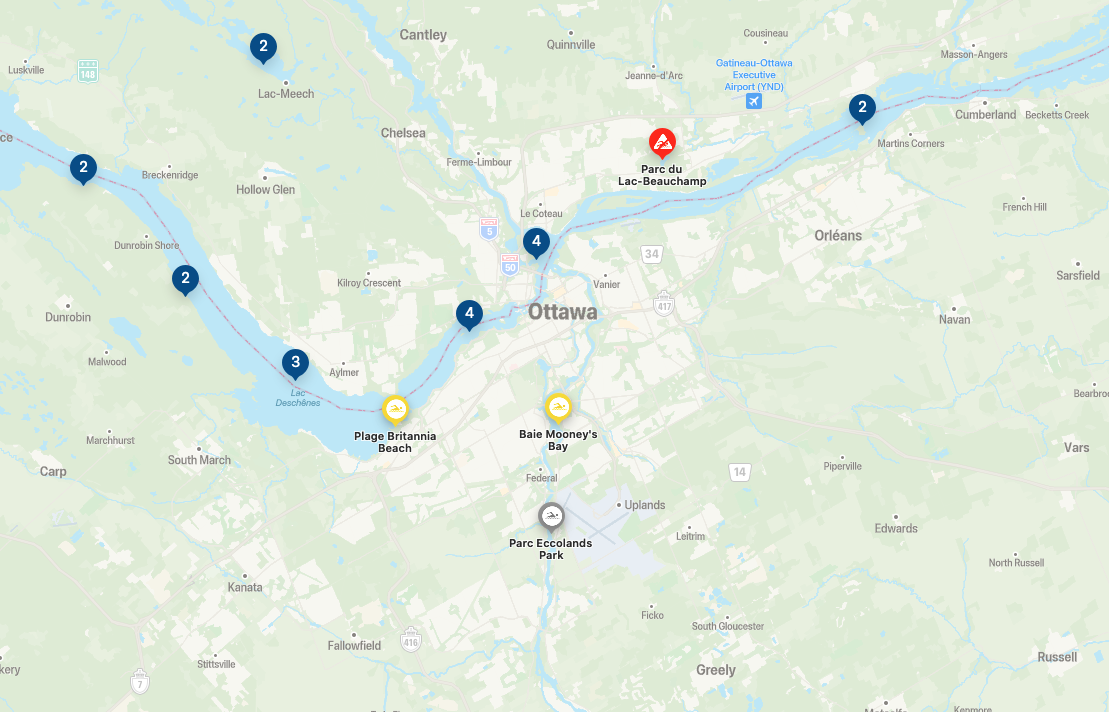
In an effort to provide information on recreational water quality to beachgoers throughout the watershed, Ottawa Riverkeeper updates Swim Guide, a mobile and desktop resource that shares the most recent water quality data for beaches and water access points across Canada and the United States. In addition to updating Swim Guide with data collected by municipalities and regional health authorities, Ottawa Riverkeeper also conducts water quality sampling and in-house E.Coli analysis for several locations in the watershed. Over the 10 years that we have been running our Swim Guide programs we have seen first hand how quickly E.Coli levels and water quality can change from day-to-day, especially at urban beaches that are more susceptible to CSOs and pollution runoff.
Use Swim Guide’s “beach finder” to find your local
beach and check water quality before visiting
Another freshwater phenomenon to keep an eye out for when looking for a safe place to swim are algal blooms. An algal bloom is any over production of algae that is greater than average for a given water body. While algae is present in all freshwater environments year-round, increased amounts of nutrients like phosphorus higher temperatures are known to promote the rapid growth of algae, leading to algal blooms. In the Ottawa River watershed algal blooms tend to be made up of either green or blue-green algae (also known as cyanobacteria). While blooms of green algae can be unsightly and produce unpleasant odours they are generally not dangerous for swimmers. Blooms of blue-green algae on the other hand, have the potential to produce toxins, like Microcystin, which can be very dangerous to humans and animals who happen to come in contact with or consume it. Since we began tracking the occurrence of algal blooms in the watershed in 2019 there has yet to be a summer without at least one beach closure somewhere in the watershed because of an algal bloom!
Outside of water quality and algal blooms, there are several other potential hazards to keep an eye out for when choosing a place to swim. Swimming in and navigating large, dynamic water bodies like the Ottawa River means always being on the lookout for safety concerns, which is why it is best to always have a buddy with you when you are out on or in the water and as well as letting someone on land know where you are. Things like sudden changes in weather, underwater hazards, and hydroelectric dams can also pose a threat to your safety when on or in the water. Before heading out for a swim, check the weather forecast, and be sure to obey any warning signs or barriers near dams.
Pick your next topic to explore: