
Posted: May 29, 2026
Federal Court of Appeal upholds the Species at Risk Act
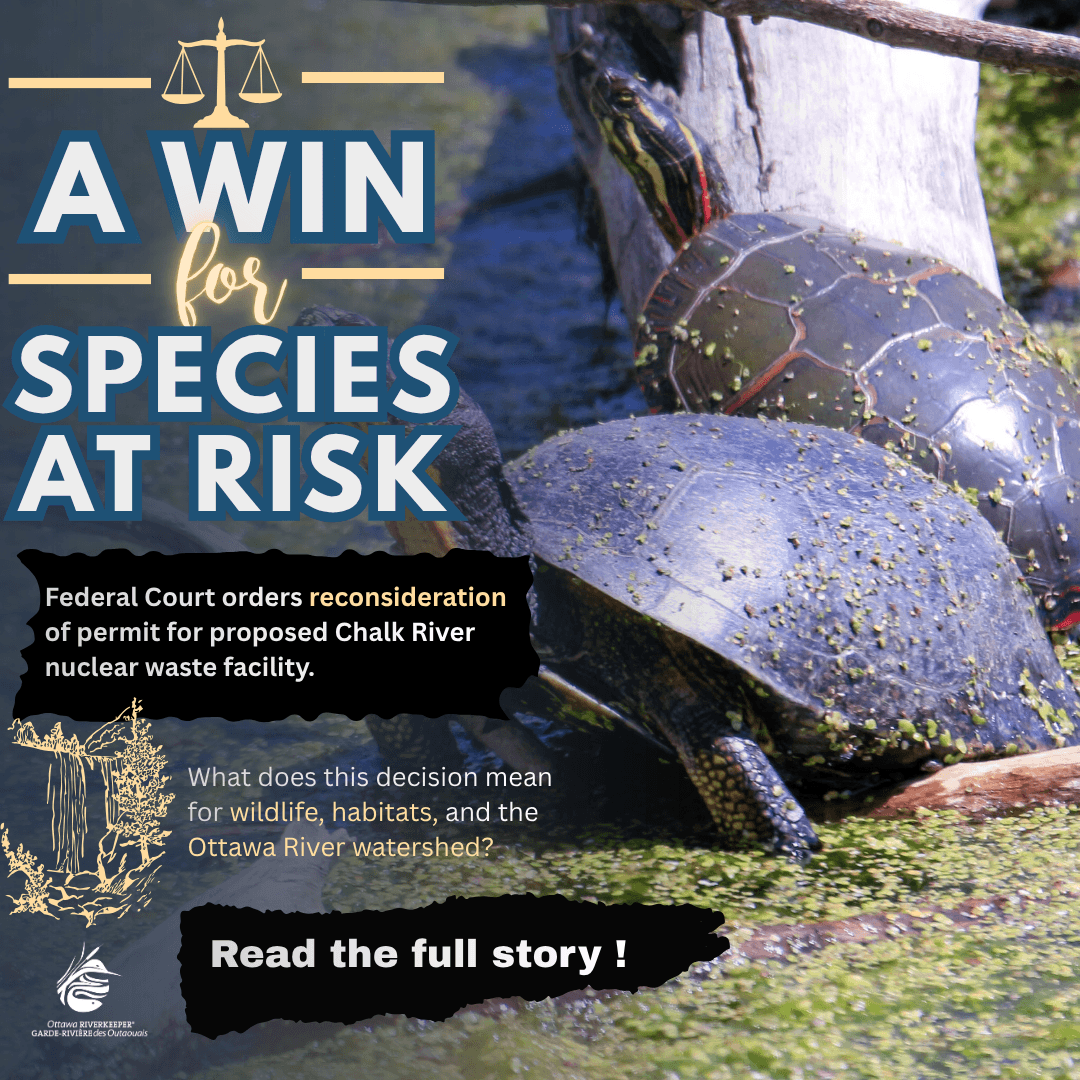
A recent Federal Court of Appeal decision has directed Environment and Climate Change Canada to reconsider a permit granted for the proposed Near Surface Disposal Facility at Chalk River Laboratories. The ruling marks a significant moment for species-at-risk protection and raises important questions about the future of one of the most ecologically sensitive areas along the Ottawa River watershed. Read more about the decision and what it could mean for wildlife, habitats, and river protection.
On May 28th, 2026, the Federal Court of Appeal delivered the decision directing the Minister Environment and Climate Change Canada (ECCC) to “redetermine” its decision to grant a Species at Risk permit to Canadian Nuclear Laboratories which allowed the construction of the Near Surface Disposal Facility (NSDF) at Chalk River Laboratories.
< Previous postThe discretion of the Minister of ECCC to issue a permit for the NSDF was successfully challenged in Federal Court by Kebaowek First Nation, Concerned Citizens of Renfrew County and Area, Canadian Coalition for Nuclear Responsibility, and Sierra Club Canada Foundation. Their submission to the court and this subsequent appeal, has demonstrated that ECCC did not meet the conservation objectives of the Species At Risk Act when issuing the permit.
Ottawa Riverkeeper has engaged on the activities at Chalk River Laboratories and we have intervened specifically on the proposal for an NSDF.To emphasize the particular flora and fauna affected by the proposed NSDF, we are sharing part of an opinion piece published in the Hill TImes on April 29th, 2026 by Lynn Jones which describes the species and habitats found on the site of the proposed NSDF:
From the Hill Times on April 29, 2026:
Can Canada’s Species-at-risk Act protect endangered wildlife on federal land? A pending Federal Court of Appeal ruling might hold the answer.
Opinion piece written by Lynn Jones is a member of Concerned Citizens of Renfrew County and Area.
There’s a beautiful, wild, south-facing hillside, close to the Ottawa River, not too far upstream from Parliament Hill. It is densely forested with mature stands of deciduous and coniferous trees and partly surrounded by five named wetlands that drain through Perch Creek and Perch Lake into the Ottawa River.
In summer the forest is full of birdsong. Many migrating songbirds pass through the area. Rare songbirds nest in the woods on the hillside. You might hear a Wood Thrush singing, or Whip-poor-wills, or Canada Warblers, or Golden-winged Warblers, all of which are listed as threatened under the Species at Risk Act. The old trees provide ideal roosting habitat for three species of endangered bats, the Little Brown Bat, Northern Myotis and Tri-coloured Bat.
After a summer rainfall, little streams and rivulets flow down the hillside into the wetlands at its base. These wetlands and nearby Perch Lake provide abundant food for birds and bats and for many small mammals, which in turn attract larger mammals. They also support many aquatic animals such as fish, frogs, waterfowl and turtles, including endangered Blanding’s Turtles.
The hillside forest is vibrant and green, blanketed with mosses and lichens and full of diverse species of trees including endangered Black Ash. The sandy warm soil on the southwest-facing slope supports three active Black Bear dens. A deer yard provides an ideal winter feeding ground for endangered Eastern Wolves that have dens nearby.
This rich web of diverse animal and plant life is unique and rare. It likely evolved here because of the hill’s southern exposure, abundant water and extensive riparian zones where land and water meet. Lack of human interference was key. Humans have not been permitted to wander here for 80 years because it is located on the Chalk River Laboratories property, a fenced off, no-go zone since the first nuclear reactor was built there in 1945.
Incredibly, this is the very spot Canadian Nuclear Laboratories (CNL) has chosen to build its controversial, giant, above-ground nuclear waste dump called the Near Surface Disposal Facility (NSDF). CNL chose the site mainly to reduce hauling costs for one million tons of radioactive waste it plans to put in the dump. After clearcutting the forest, they would blast the hillside with explosives to flatten it, turning 37 hectares of forest into half a million tons of rock rubble.
CNL is owned by a multinational private-sector consortium that operates Canada’s federal nuclear laboratory under a $1.2 billion per year contract with the Government of Canada.
Environment and Climate Change Canada (ECCC) granted CNL a permit to destroy endangered species and their residences in order to build the NSDF. According to the Species at Risk Act, such permits should only be granted if the applicant considered all reasonable alternatives and adopted the best solution to reduce impacts on endangered species.
The ECCC permit decision was successfully challenged in Federal Court by Kebaowek First Nation and allies who believe that ECCC did not receive complete information about how the site was chosen and made errors in granting the permit. CNL appealed the lower court decision and the appeal hearing was held on November 12, 2025 in Ottawa.
Addendum: When this opinion piece was written, the decision had not yet been made. On May 28th, 2026, the Federal Court of Appeal concluded that the Minister’s decision in issuing a permit is unreasonable and that the Minister is required to redetermine their decision for a permit, in accordance with the reasons outlined in the decision, before the permit allowing this project to move to the construction phase is provided.
Leave a Reply