
Posted: August 15, 2024
Mercury Mystery: Unveiling surprising trends in the Ottawa River watershed
We have just released a detailed report on surprising and concerning findings related to mercury levels in fish within the Ottawa River watershed. While most species have mercury levels within safe limits, this emerging trend warrants closer monitoring and further study.
In our recent Watershed Report Card, Ottawa Riverkeeper revealed concerning trends tied to mercury levels in fish within the Ottawa River watershed. While mercury levels remain within safe limits for most species, they are higher on average compared to regions with more industrial activity such as Lake Ontario and Lake Saint Pierre. Now, with the release of a more detailed report of our findings, this blog aims to summarize and explain these results and their significance for the health of our watershed.
A brief overview of mercury
Mercury (Hg) contamination in fish is a significant environmental and public health concern around the world. This element occurs naturally in the environment, but human activities have increased its availability in many ecosystems. Mercury exists in different forms and can travel great distances in the atmosphere, where it can linger for extended periods before being deposited in ecosystems.
In an aquatic ecosystem, mercury can be transformed into methylmercury, the most toxic form of mercury. It can then accumulate in fish tissues, posing risks to the environment and people who consume fish as a vital food source. Larger fish species, especially predatory fish species, tend to have higher levels of mercury due to the processes of bioaccumulation and biomagnification:
- Bioaccumulation: Older and longer-lived species absorb mercury compounds from their food, leading to accumulation in their tissues.
- Biomagnification: Mercury accumulates up the food chain, resulting in larger predators having higher concentrations in their tissues.
For more on mercury, watch our video on this indicator featuring Dr. Alexandre Poulain, Professor in Biology, and Vice-Dean Research at uOttawa.
What conditions influence the presence of mercury?
Natural concentrations of mercury are typically extremely low and can be completely sequestered from the water column by sediment and vegetation. However, certain conditions can transform mercury into its more toxic form, methylmercury, which is more easily absorbed by living organisms. These conditions are present in the Ottawa River watershed and contribute to the higher concentrations of methylmercury in this region which can be seen in the data.
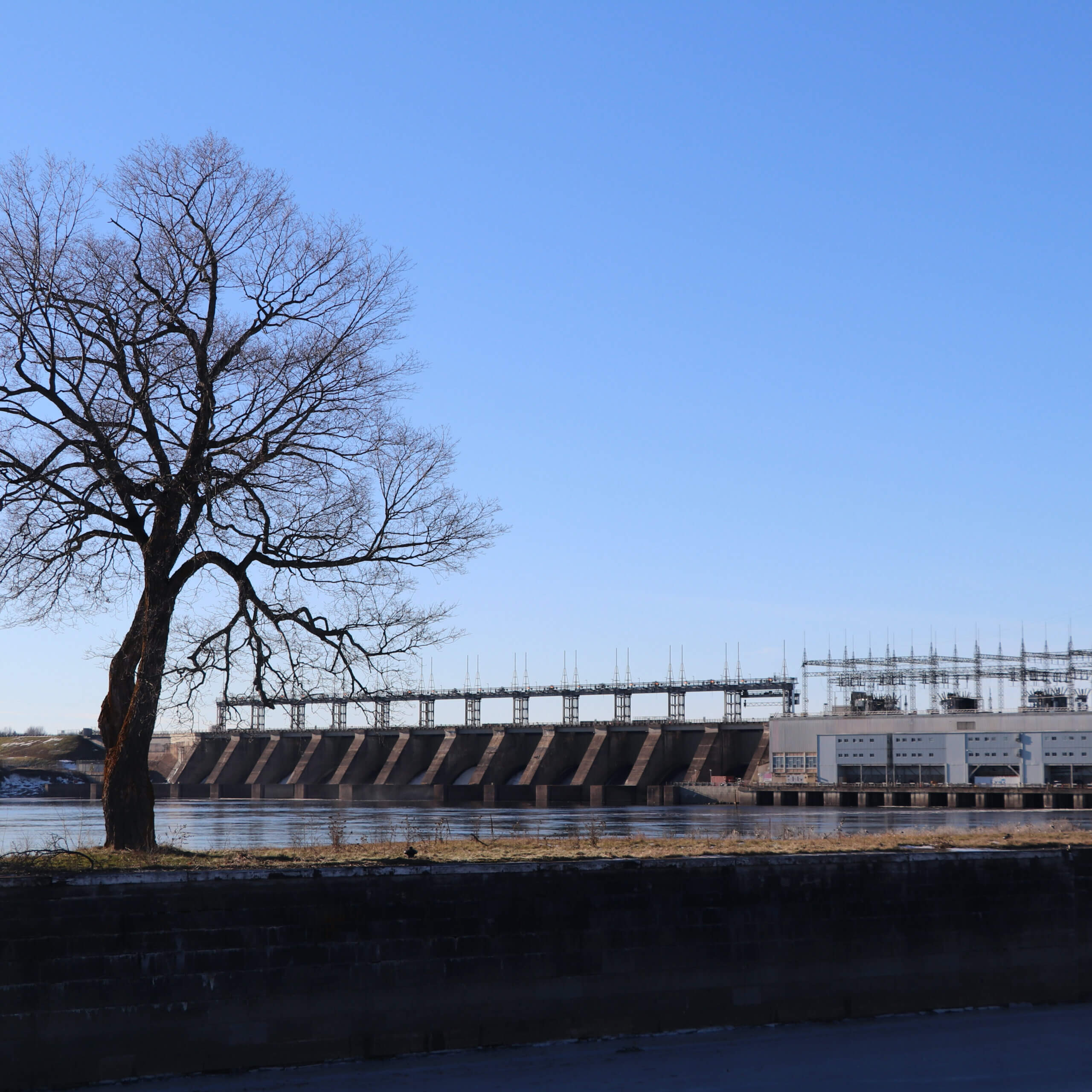
Methylmercury is more likely to be created in areas with high acidity and low oxygen levels, such as stagnant waters in reservoirs and wetlands. As a watershed with a significant number of dams and other structures that alter the natural flow of water, these reservoirs can create the ideal conditions for the transformation of mercury to methylmercury. This is not restricted to areas with large reservoirs but includes the many, many smaller dams or water level controls that have resulted in areas being inundated.
The Ottawa River is also well known for its brown coloration, which is due to plentiful organic matter from numerous lakes and wetlands. This provides an environment in which mercury can easily bind with organic material, influencing its distribution and bioavailability. With the geology of the Canadian Shield lacking significant deposits of calcium, there is also little natural buffering against acidic conditions in many areas of the watershed.
Altogether, the presence of dams, the brown colour of the river due to organic materials, and fewer natural buffers against acidity contribute to making the Ottawa River particularly vulnerable to higher amounts of mercury becoming available. Understanding these geological and hydrological influences is crucial when examining mercury levels in the Ottawa River watershed.
What did our analysis uncover?
Our study analyzed data from 1970 to 2022 at around 540 sites in the watershed. This consisted of 26,000 records covering 37 fish species. We focused on Walleye, Northern Pike, Smallmouth Bass, and Lake Trout due to the abundance of data for these species and because they are all top predators, feeding primarily on smaller fish, invertebrates and other organisms.
Looking at the historical trends, we found that mercury concentrations peaked in the 1970s, decreased to their lowest levels in the 1990s/2000s, and have been rising again in recent years. This increase is consistent with a 2013 Government of Canada report noting a rising trend in mercury levels after 2000.
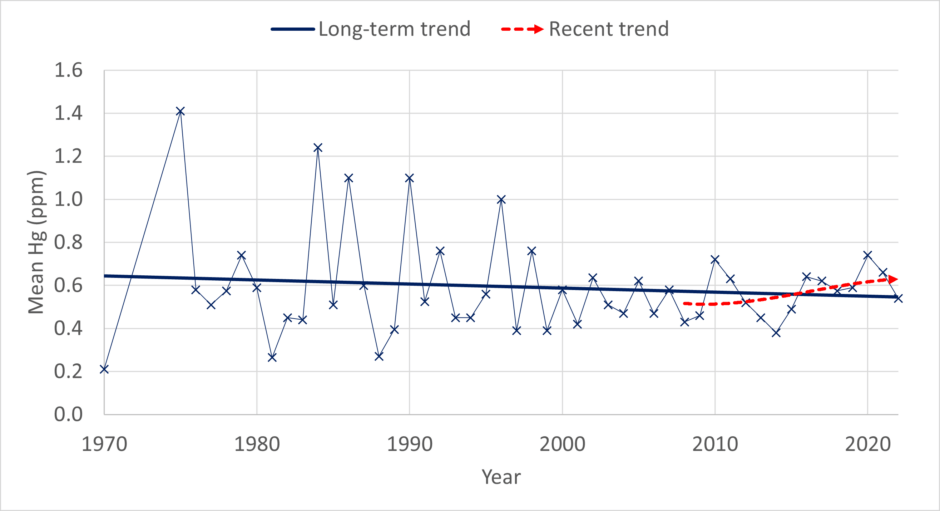
Long-term and recent trends of mean mercury levels for Walleye within the Ottawa River watershed.
Today, mercury levels in most fish species within our watershed remain below the provincial consumption guidelines. However, they are higher than the averages for Ontario and Quebec. Importantly, despite global reductions in mercury emissions, recent data shows that mercury levels in some fish species are nearly as high, or even higher than in the 1970s/80s. In some species, like Walleye and Northern Pike, we see levels that exceed the limit set out within the consumption guidelines.
The elevated mercury levels we’ve observed can result from various factors, including global emissions, changes in land use, climate change, dam infrastructure, higher temperatures, wastewater, and the presence of invasive species. Recent increases observed in the data may be linked to global mercury emissions, particularly from Asia, which are transported to our region through atmospheric currents.
What does this all mean?
Mercury levels in the Ottawa River watershed’s fish are an important trend to monitor. Fish consumption data is widely available for hundreds of locations in the Ottawa River watershed. However, it was only once this data was analyzed at a watershed scale that Ottawa Riverkeeper began to comprehend the conditions in the watershed. Increased monitoring of mercury levels and further research into these trends and their potential causes are needed to better understand and address this issue.
While we emphasize that levels remain within the consumption guidelines for many species, the recent increases warrant close attention and a better understanding of the conditions in the watershed leading to this rise. Finding ways to reduce or mitigate these conditions, particularly as they interact with a changing climate, will be key to keeping mercury below levels that impact human and ecosystem health. In addition, since mercury is often transported great distances from where it was first released via the atmosphere, global cooperation is crucial in reducing mercury emissions worldwide.
By staying informed and involved, we can help advocate for a healthier future for the Ottawa River, for all generations and all species.
For more detailed information, please refer to our full report available on Ottawa Riverkeeper’s Open Data Portal.
You can also watch a recording of a webinar on these findings, featuring additional information on the mercury cycle and how it enters our ecosystems from guest expert Dr. Alexandre Poulain.
I cannot believe a Riverkeeper society whose mandate is clean, swimmable, biodiverse rivers would cancel a swim event and have a golf tournament instead.
Pesticides, insecticides, herbicides, fertilizer toxic wastelands of zero biodiverse ‘lawns’ .
Sickening.