Posted: February 2, 2024
Piloting a New Road Salt Monitoring Methodology in 2023-2024
Ottawa Riverkeeper’s road salt monitoring initiative has uncovered alarming levels of chloride in local creeks for the past 4 years. We explore what the program is finding this year, and how we continue to evolve our monitoring to make it faster, easier, and cheaper to keep tabs on our local freshwater ecosystems.
In January 2020, Ottawa Riverkeeper first launched our pilot road salt monitoring study. That initial study confirmed very concerning levels of road salt contamination in the urban creeks tested. Every winter since, we have continued to evolve the program with new sites, more volunteers, and new ways of looking at the data.
The 2023-2024 monitoring season

Photo by Evan Moore
This winter, the science team at Ottawa Riverkeeper is trying a few new methods to assess the chloride concentrations in local streams. After 4 years of collecting data, two big questions have come up: is it possible to get a more precise location for where road salt pollution is occuring within creeks, and are there other techniques that are more cost-effective and could allow for more participation?
With these questions in mind, the science team and our dedicated volunteer community scientists have embarked on a new pilot program to get some answers. The new strategies we are testing are being instituted alongside our existing methodology. This means that we will be able to compare the results of our pilot study with our existing data methods and have a robust data set to fall back on if the pilot study does not go as planned.
The new pilot involves two changes in strategy from previous years:

1: Targeting multiple sites along the same streams
To better understand the dynamics of road salt within urban streams, we added monitoring sites this year that target the upstream and downstream sections for 7 of our streams. By sampling at multiple sites along the same stream, we can get a clearer picture of how the landscape surrounding the stream is impacting road salt concentrations within the stream.
Put another way: are pollutants accumulating as streams flow downstream or do they become diluted? Through this study, we hope to better understand what is occurring in these streams.
2: Trying out new methods for testing chloride concentrations
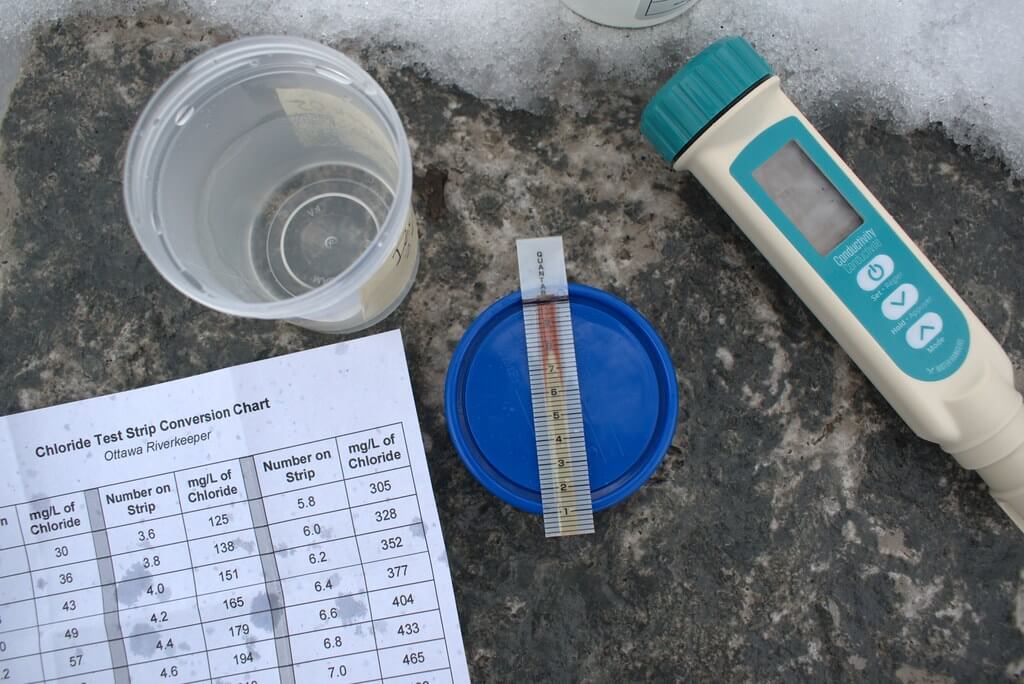
As we add more locations and more volunteer community scientists to our monitoring program, we are searching for new techniques that are more cost-effective and provide results more quickly. This year, we are testing to see if Quantab Chloride Strips could be an addition to our program.

Each participant who signed up for the Chloride Test Strip pilot received a kit containing everything they needed to collect a sample and use the Quantab Chloride Test Strips. So far, the results look promising! The test strips are easy to use, working something like a combination of pH strips and COVID tests. They are also significantly cheaper than other methods, allowing us to have even more volunteers out monitoring!
Another benefit to using the Quantab Test Strips is that they are becoming a more popular solution for other groups running road salt monitoring programs. Why is this a good thing? If more programs are using this same sampling protocol, then the data we collected by all these programs can be easily compared. This allows us to put the trends we see in the context of data from other cities, around the country, and even internationally.
What is our data telling us about road salt in Ottawa and Gatineau?
Thanks to the efforts of our amazing community scientists over the last 4 years, we’ve accumulated quite a lot of data on chloride concentrations in urban streams and creeks in the National Capital Region. We’ve sampled a total of 30 streams regularly throughout the winter, with 90% of the sites routinely containing levels of contamination from salt that cause harm to freshwater species.
As the program continues to expand, we can get a clearer picture of the harm that road salt is causing to urban aquatic ecosystems. Trends are beginning to emerge. Areas such as Nepean and Orleans are consistently above the acute chloride toxicity threshold in the winter, whereas Kanata and Hull, among other areas, are consistently above the chronic chloride toxicity threshold.

| What is Acute and Chronic Toxicity? |
|---|
| As a reminder, “acute” and “chronic” chloride toxicity thresholds refer to the water quality guidelines published by the Canadian Council for Ministers of the Environment. These guidelines establish two ranges where chloride concentrations could be harmful to freshwater aquatic organisms. Chronic toxicity occurs when chloride concentrations are between 120mg/L and 640mg/L for an extended period (more than 4 days). After prolonged conditions of these high concentrations, there can be a significant loss in biodiversity within freshwater ecosystems. Acute toxicity occurs when chloride concentrations are above 640mg/L. Exposure to acute chloride toxicity can be fatal to freshwater aquatic organisms, even if the high concentrations are not prolonged. |
In 2023, we took the additional step of sampling during the summer as well. That data was alarming, showing high chloride concentrations well after road salt had been spread during the winter. Although the samples didn’t hit the threshold for acute toxicity, many sites still exceeded the chronic toxicity threshold. This means that the salt we put on our roads in the winter is harming the organisms in our streams year-round.
We’ve collected the data into an animated graphic below, to illustrate both the distribution of levels of chloride around the region, as well as the growth and expansion of the program over the years.

Figure 1: Median concentrations of Chloride from the Ottawa Riverkeeper’s Road Salt Monitoring Program (2020-2023).
So far this year, chloride concentrations are similar to what we have seen in previous years. Nepean Creek (Nepean) and Bilberry Creek (Orleans) consistently contain high chloride concentrations at our test sites, whereas Des Fees Creek (Gatineau) is often within the “safe” limits of chloride. Overall, 47% of the samples that we have collected so far this year are above the acute threshold. We are already seeing concentrations as high as 2000 mg/L, over 10 times higher than the safe limit! This means that many of our creeks around the National Capital Region are at risk, containing concentrations of chloride that could severely impact many species.
Conclusion
With more freeze-thaw cycles to come over the next few months, we will be keeping a close eye on chloride concentrations. If you would like to help our monitoring efforts, you can contact us at CBM@ottawariverkeeper.ca. We will be recruiting volunteers for the 2024-2025 Road Salt Monitoring program starting in the fall.
Road salt overuse is a solvable problem, but requires a move away from our culture of overreliance on this toxic substance. While decision-makers and private companies tackle the issue on a larger scale, there is plenty individuals can do to reduce their road salt use. Check out our 5 Tips to Reduce Your Road Salt Use for actions you can take!